
Bank vs Alternative Lender: Which Business Loan Is Right for You?
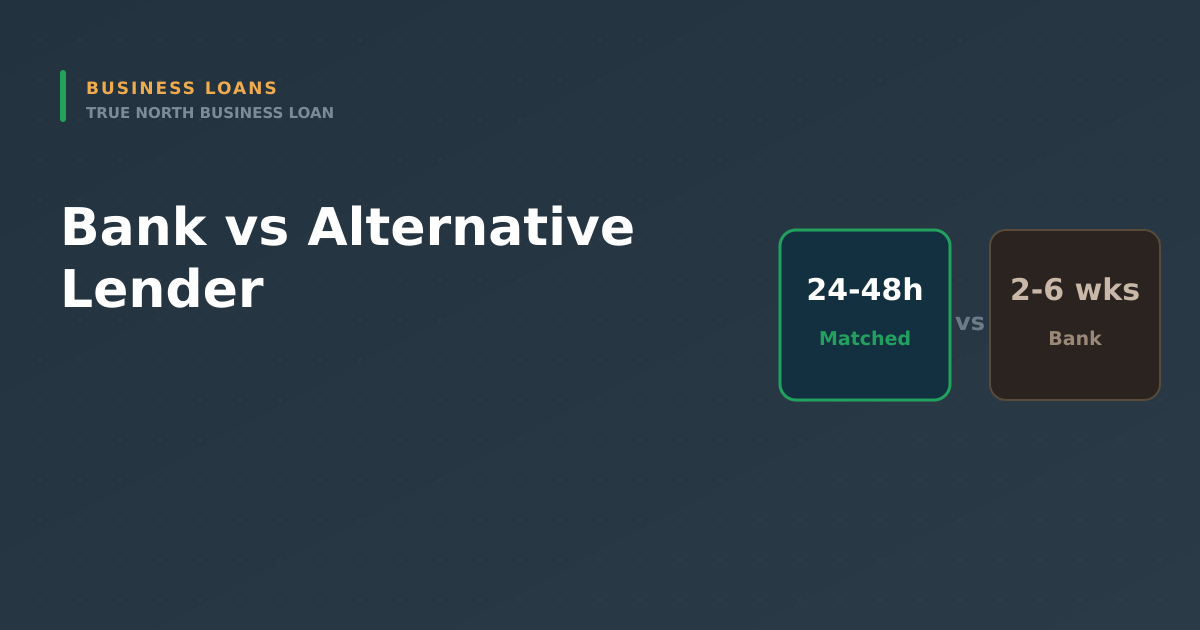
Choosing between a bank and an alternative lender comes down to your timeline, qualifications, and specific capital needs. Traditional banks offer the lowest interest rates but enforce strict qualification rules and take weeks to process applications. Alternative lenders prioritize funding speed and revenue-based approvals, delivering capital in 24 to 48 hours for a slightly higher overall cost.
Banks suit established businesses with high credit scores and flexible timelines. Alternative lenders serve businesses that need fast funding, flexible requirements, or capital to seize time-sensitive growth opportunities.
What is the core difference between a bank and an alternative lender?
The primary difference lies in how each institution evaluates risk and delivers capital. Canadian chartered banks use rigid underwriting models based on historical financial statements, high credit scores, and physical collateral. Alternative lenders use technology-driven underwriting that evaluates your current monthly cash flow, daily revenue, and real-time business health.
Banks operate under strict federal regulatory frameworks. These requirements protect depositors but make it difficult for commercial loan officers to approve non-standard files. A business operating for under three years or experiencing seasonal revenue dips often fails automated bank scorecards immediately.
Alternative lenders fill this institutional gap. By assessing recent operating performance rather than multi-year tax archives, they approve loans from $5,000 to $800,000 for companies that standard institutions reject. You can evaluate your company's funding eligibility quickly through our 60-second loan estimator without impacting your credit score.
How do bank business loans work in Canada?
Bank business loans are structured commercial financing packages provided by major financial institutions. When you apply for a standard bank term loan, you must provide three years of corporate tax returns, personal financial statements, and detailed profit and loss records. The underwriting process involves manual review by branch underwriters and regional risk committees.
Banks secure their exposure by requiring tangible collateral. This collateral often includes commercial real estate, heavy equipment, or broad personal guarantees backed by personal assets. If your company lacks unencumbered hard assets, qualifying for unsecured bank capital is exceptionally difficult.
The bank approval process typically takes between four and eight weeks from initial application to final disbursement. This extended timeline works well for long-term real estate acquisitions or planned multi-year expansions. It does not work when you need immediate working capital to fulfill customer contracts or buy urgent inventory.
For owners seeking traditional term structures with clear amortization schedules, exploring small business loans through specialized commercial providers often delivers a smoother experience than standard bank branches.
How do alternative business loans work in Canada?
Alternative lenders provide non-bank commercial financing through modern digital platforms. Instead of demanding extensive paper documentation, these lenders analyze secure electronic bank statements covering the past four to six months. Underwriting algorithms measure monthly gross revenue, daily cash flow consistency, and operational resilience.
This streamlined process allows alternative lenders to issue approvals within 24 to 48 hours. Once approved, funds frequently land in your commercial account the following business day. The speed of execution allows owners to solve sudden operational hurdles or capitalize on time-sensitive inventory discounts.
Alternative lenders offer diverse financial products tailored to specific operational needs. These products include revenue-based merchant advances, accounts receivable factoring, and asset-backed equipment financing. Each structure addresses a distinct cash flow requirement without requiring traditional real estate collateral.
The trade-off for this flexibility and rapid execution is a higher cost of capital. Alternative lenders price risk based on short-term speed and accessibility rather than long-term asset security.
How do bank and alternative loan approval criteria compare?
Bank approval criteria focus on historical risk minimization, whereas alternative lenders evaluate current operational momentum. Banks require high credit scores, positive multi-year debt service ratios, and extensive documentation before considering an approval.
Alternative providers place less emphasis on past personal credit challenges. If your business generates consistent monthly revenue and shows healthy bank activity over the past six months, you can qualify even with an imperfect credit history.
| Evaluation Metric | Traditional Bank | Alternative Lender |
|---|---|---|
| Approval Speed | 4 to 8 weeks | 24 to 48 hours |
| Minimum Time in Business | 24 to 36 months | 6 months |
| Credit Score Requirement | Strict (680+) | Flexible (550+) |
| Documentation Required | 3 years tax returns & audits | 4-6 months bank statements |
| Collateral Requirement | Hard assets or real estate | Revenue or asset-specific |
What are the true cost trade-offs between speed and interest rates?
Interest rate is only one component of the total cost equation in commercial financing. Traditional bank loans carry the lowest annual percentage rates, making them the most cost-effective solution for permanent capital investments over five to ten years.
However, calculating the true cost of borrowing requires measuring opportunity costs. If a bank takes seven weeks to reject an application, your business may lose valuable bulk inventory pricing or fail to onboard a lucrative commercial client. In that scenario, waiting for cheap capital results in net lost profit.
Alternative financing models carry higher borrowing costs, but their rapid deployment generates positive returns on rapid-turnaround projects. If borrowing $50,000 costs $6,000 in financing fees but allows you to generate $25,000 in net gross margin over 90 days, the investment delivers clear commercial value.
Compare the total dollar cost of capital directly against the net profit generated by deploying the funds immediately. Never look at interest rates in isolation.
What mistakes should business owners avoid when choosing a lender?
Choosing the wrong financing partner can restrict cash flow or create unnecessary administrative friction. Many owners make strategic errors because they do not fully understand lender specialization or application consequences.
Submitting blind applications to multiple traditional institutions at once is a frequent error. Each bank files a hard credit inquiry on your personal bureau, which drops your score and triggers automated fraud warnings across secondary underwriting systems.
- Applying everywhere at once: Multiple hard credit inquiries within short windows damage personal credit scores and trigger automated declines from institutional risk systems.
- Ignoring cash flow repayment terms: Choosing daily or weekly remittance models without verifying your receivables cycle can strain operating liquidity during seasonal dips.
- Failing to match the loan product to the asset: Using short-term working capital to purchase long-life heavy machinery results in mismatched cash amortization and unnecessarily high debt service costs.
When should you choose a bank versus an alternative lender?
Choose a traditional bank when your financing need is not time-sensitive, your business holds strong multi-year audited financial records, and you possess unencumbered physical assets to pledge. Banks remain the premier choice for purchasing commercial property, refinancing existing long-term debt, or funding multi-year corporate buyouts.
Choose an alternative lender when you need capital immediately to capture revenue, purchase equipment, or manage short-term seasonal fluctuations. If your business has operated for at least six months and generates steady monthly sales, alternative lenders offer flexible terms tailored to your real cash cycle.
Many growing Canadian companies utilize both models simultaneously. They maintain a primary banking relationship for everyday commercial accounts while leveraging specialized non-bank lenders for agile growth initiatives that require funding within 24 to 48 hours.
Frequently asked questions about bank vs alternative lenders
Will applying to an alternative lender hurt my credit score?
Most alternative lending platforms begin with a soft credit inquiry that does not impact your credit score. A formal hard pull only occurs once you accept an offer and proceed to final loan documentation.
Can I qualify for an alternative loan if a bank turned me down?
Yes, alternative lenders operate under different risk criteria. They focus primarily on your recent six months of gross cash flow and operating performance rather than historical credit blemishes or lack of hard collateral.
How fast can an alternative lender transfer business funds?
Approvals typically take 24 to 48 hours after submitting digital bank statements. Once loan contracts are executed, funds are transferred directly to your operating account within one business day.
What is the minimum revenue required for alternative financing?
Most alternative lenders require a minimum of $10,000 in gross monthly revenue and at least six months of continuous operational history. Requirements vary depending on the specific loan structure selected.
Are alternative business loans available across all Canadian provinces?
Yes, alternative commercial financing operates across all Canadian provinces and territories, subject to provincial lending guidelines and standard business registration verifications.
Ready to Get Started?
Use our Business Loan Estimator to see what financing options are available for your business.
Get My Loan Estimate