
Business Line of Credit vs Term Loan: Which Should You Choose?
What is the main difference between a business line of credit and a term loan?
The primary difference lies in how you access funds and repay the balance. A business line of credit provides flexible, revolving capital that you draw as needed. A term loan delivers a single lump-sum disbursement with a structured, fixed repayment schedule.
Choose a business line of credit for recurring expenses, seasonal gaps, and emergency liquidity. Opt for a term loan when funding large, one-time capital investments with predictable returns.
With a line of credit, you only pay interest on the exact amount you withdraw. Once you repay the borrowed principal, your available credit limit restores automatically. This revolving mechanism operates much like a high-limit business credit card, but typically carries lower borrowing costs.
In contrast, a commercial term loan amortizes over a predetermined duration, ranging from several months up to several years. You start paying interest on the entire principal balance immediately upon disbursement. Canadian business owners often use term loans to finance predictable expansions, asset acquisitions, or facility upgrades.
How does a business line of credit work for Canadian companies?
A business line of credit acts as an open-ended funding pool that remains available until you choose to draw on it. Lenders approve your company for a maximum credit limit based on your operational revenue and credit profile.
When cash flow fluctuates, you can transfer capital directly into your operating bank account. You can borrow $10,000 one week to cover inventory shortages and repay it the following month. Because interest accrues daily only on active draws, the cost remains entirely within your operational control.
This revolving structure makes lines of credit ideal for managing working capital volatility. Many Canadian businesses secure a facility before they experience a cash squeeze. Having standby capital protects payroll, vendor relationships, and daily operations against unexpected customer payment delays.
Alternative lending networks in Canada frequently establish lines of credit from $5,000 to $800,000 without the prolonged underwriting delays seen at traditional commercial banks.
How does a business term loan function?
A term loan provides your enterprise with a fixed sum of upfront capital deposited directly into your bank account. You then repay this capital through scheduled weekly, bi-weekly, or monthly installments over a set timeframe.
Every payment consists of principal reduction alongside interest charges, ensuring the debt clears fully by the end of the term. This payment predictability simplifies bookkeeping and cash flow forecasting for growing enterprises. You always know the exact debt service cost for each billing cycle.
Term loans are structured specifically for tangible growth initiatives where you deploy capital all at once. Common applications include expanding commercial footprints, purchasing heavy inventory, or executing strategic marketing campaigns. Business owners who require dedicated asset funding often evaluate equipment financing alongside standard term loans.
For companies seeking dedicated expansion capital, our matched small business loans offer structured repayment schedules tailored to existing cash flow rhythms.
How do costs and structures compare between both options?
The overall cost of borrowing depends on how quickly you deploy and return the capital. Term loans calculate interest across the entire initial principal, while credit lines accrue charges exclusively on withdrawn funds.
| Financing Feature | Business Line of Credit | Commercial Term Loan |
|---|---|---|
| Disbursement Type | Revolving (draw as needed) | Single lump-sum payment |
| Interest Application | Active balance only | Full principal balance |
| Payment Flexibility | Variable based on usage | Fixed, structured installments |
| Best Use Case | Working capital & emergencies | Major one-time investments |
| Reusable Capital | Yes (revolving limit) | No (requires new loan) |
Term loans frequently feature fixed rates or set factor fees, keeping financing costs stable throughout the loan life. This stability eliminates interest rate volatility risks for large-scale balance sheet adjustments.
Lines of credit may involve secondary fees, such as nominal annual maintenance fees or draw administration charges. However, avoiding interest charges on unborrowed funds often makes a credit facility more economical for unpredictable cash requirements.
Which financing option should you choose for your operational goals?
Selecting between these two loan types requires aligning your borrowing structure with the financial lifecycle of your project. Mismatched financing structures can unnecessarily inflate borrowing expenses or strain monthly cash reserves.
Match the lifespan of the loan to the lifespan of the asset. Use revolving lines for short-term working capital cycles under 12 months, and use term loans for multi-year capital assets.
Choose a line of credit if your revenue is highly seasonal or if your clients operate on extended 60-day payment terms. The facility bridges temporary cash deficits without forcing you into fixed multi-year liabilities. It also serves as an indispensable emergency reserve for unexpected equipment repairs or sudden supply chain disruptions.
Choose a term loan if you are acquiring high-value machinery, hiring permanent staff, or opening a new location. These multi-year investments generate steady monthly revenue, making predictable installment schedules much easier to service.
What common mistakes do business owners make when choosing debt?
The most frequent error is utilizing a short-term credit facility to fund permanent fixed assets. Drawing heavily on a credit line for real estate improvements locks up your available working capital, leaving zero liquidity for standard operational overhead.
- Overpaying interest on idle funds: Taking a large term loan when you only need occasional liquidity forces you to pay interest on money sitting in your bank account.
- Depleting emergency lines for long-term projects: Tying up a revolving facility in illiquid projects prevents you from managing payroll or sudden supplier demands.
- Ignoring structured amortization benefits: Relying indefinitely on interest-only line payments can leave principal balances untouched for years, increasing aggregate borrowing costs.
Another major mistake involves taking a large term loan when capital needs are uncertain. Paying interest on hundreds of thousands of dollars while funds sit idle reduces your net operational margins.
Canadian business owners should always evaluate their immediate cash conversion cycle before committing to a specific debt product.
What do Canadian lenders require to qualify for each product?
Approval requirements for both products focus on historical cash flow stability and business operational tenure. Canadian lenders evaluate your company's ability to support recurring debt payments without compromising daily operations.
Most alternative lending providers require at least 6 months of active operations and consistent monthly revenues of $10,000 or more. Underwriters analyze recent commercial bank statements to verify steady deposits, positive closing balances, and manageable non-sufficient fund activity.
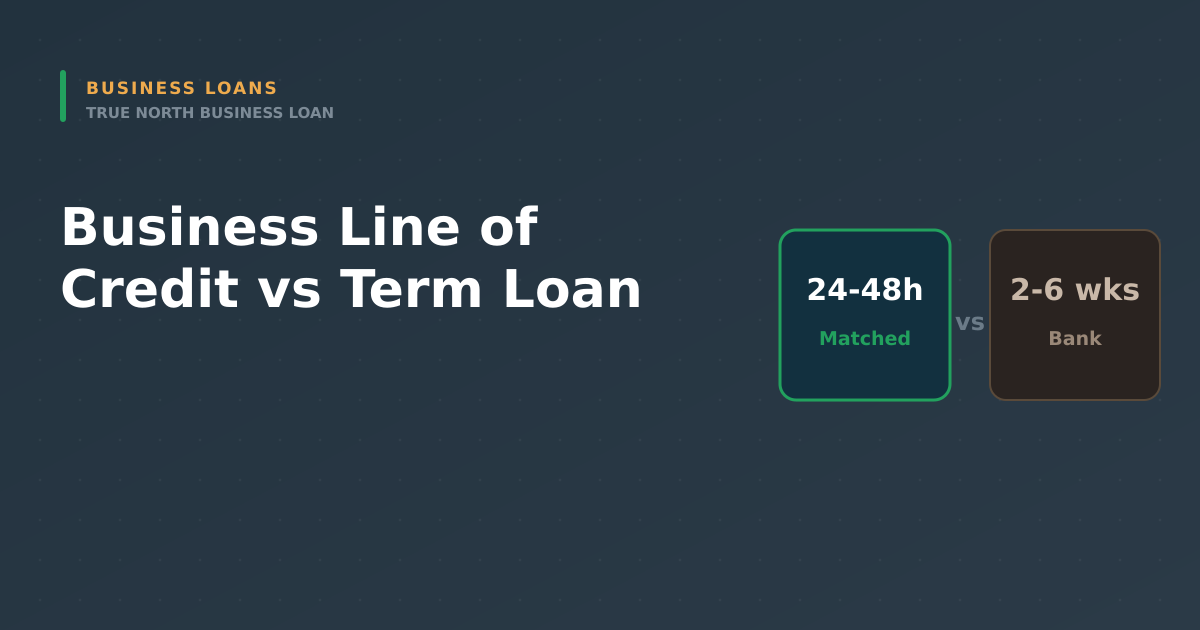
Traditional chartered banks frequently demand extensive collateral, multi-year audited financial statements, and weeks of underwriting review. Alternative lending networks evaluate applications much faster, delivering credit decisions within 24 to 48 hours.
You can review qualified options across multiple Canadian providers through a simple online loan estimator that uses a soft credit inquiry without impacting your credit score.
Frequently asked questions about lines of credit and term loans
Can a Canadian business hold both a line of credit and a term loan simultaneously?
Yes, many established businesses maintain both products simultaneously. Companies often hold an open line of credit for working capital fluctuations while servicing a term loan for long-term physical assets, provided total debt service ratios remain healthy.
Does applying for business financing impact my personal credit score?
Initial matching through alternative lending platforms generally relies on a soft credit check, which leaves no footprint on your credit profile. A hard inquiry typically occurs only when finalizing loan contracts with a specific funding provider.
How quickly can funds be accessed once approved?
Alternative business loans and credit facilities in Canada typically complete underwriting within 24 to 48 hours. Once agreements are executed, capital is frequently deposited into your operating account within one business day.
Can I repay a term loan early to save on total interest?
Early repayment terms depend on the specific lender contract. Many alternative term loans allow penalty-free early payoffs or offer early payment discounts, while others use fixed total repayment amounts regardless of payoff speed.
Is collateral always required for a business line of credit?
Unsecured business lines of credit are widely available for Canadian businesses demonstrating robust, predictable monthly revenues. Larger facilities or higher-risk profiles may require a general security agreement or specific asset backing.
Ready to Get Started?
Use our Business Loan Estimator to see what financing options are available for your business.
Get My Loan Estimate