
Equipment Financing in Canada: How to Qualify and What It Costs
Acquiring commercial machinery, heavy vehicles, or specialized software is one of the fastest ways to expand a Canadian business. However, paying cash for expensive capital assets can drain your working capital and create cash flow bottlenecks. Equipment financing allows you to spread the asset cost over its useful lifespan while keeping your operational funds intact.
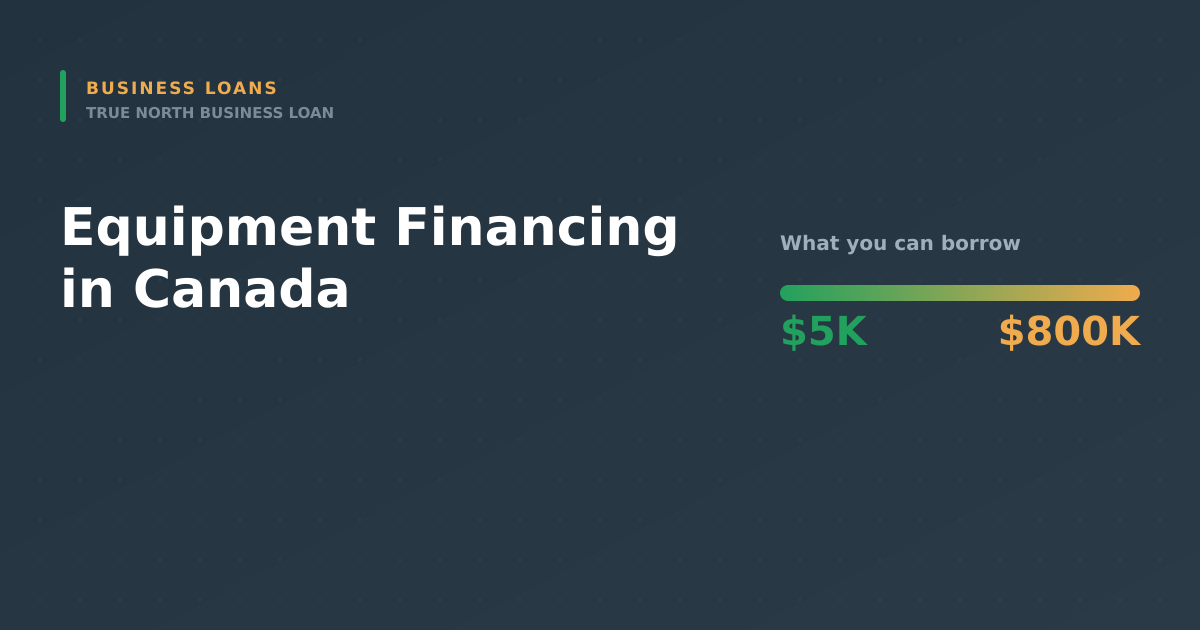
Equipment financing uses the purchased asset as collateral, allowing Canadian small businesses to qualify for funding between $5,000 and $800,000 with lower credit thresholds and faster approvals than traditional unsecured loans.
What is equipment financing and how does it work in Canada?
Equipment financing in Canada is a structured business loan or lease designed specifically to fund physical or technological business assets. The key mechanism of equipment financing is that the asset itself acts as primary collateral for the debt. This security backing reduces risk for the lender, which makes approval significantly easier than for traditional uncollateralized lending products.
When you secure funding, the lender pays the equipment vendor directly or reimburses your business after purchase. You then make fixed monthly payments over a set term, typically ranging from 12 to 72 months. Because the repayment schedule aligns with the revenue generated by the asset, your business maintains positive cash flow throughout the term.
Canadian small businesses can access funding from $5,000 up to $800,000 depending on the asset type and revenue profile. Approvals are frequently finalized within 24 to 48 hours, providing immediate utility without month-long waiting periods. You can explore suited options using our 60-second loan estimator without impacting your personal credit score.
How do you qualify for equipment financing in Canada?
To qualify for equipment financing in Canada, lenders look at a combination of your operational history, monthly revenue, and vendor quotes. Because the equipment secures the loan, approval standards focus more on your business cash flow and asset value than on flawless credit scores.
Most alternative lenders require a minimum of six months in business and a consistent monthly revenue stream. Traditional banks often demand two years of audited financial statements, but specialized equipment lenders evaluate recent bank statements to verify steady deposits instead. Having an official quote or invoice from an established supplier is also mandatory before underwriting begins.
While personal credit is considered during underwriting, minimum thresholds are significantly lower than bank requirements. Businesses with credit scores around 600 can still qualify if the asset holds strong resale value and business revenue remains stable.
- Six months in business: Minimum operational history for alternative Canadian lenders.
- Verifiable monthly revenue: Consistent bank deposits demonstrating debt coverage capability.
- Equipment quote or invoice: Itemized invoice from a recognized vendor or dealership.
- Valid Canadian business entity: Active business registration, sole proprietorship, or incorporation.
How much does equipment financing actually cost?
The cost of equipment financing in Canada depends on your credit profile, asset depreciation rates, loan term, and total funding amount. Monthly costs consist of principal repayment, interest or lease factors, and occasional processing fees charged at closing.
Hard assets like heavy construction vehicles or CNC machinery hold resale value for long periods, leading to lower financing costs. Soft assets such as specialized software or short-lived technology depreciate rapidly and may carry slightly higher factors. Term lengths directly influence your monthly obligation: longer terms decrease monthly payments but increase total interest paid over time.
It is crucial to balance your monthly payment against the asset's projected revenue output. If a $50,000 piece of equipment generates $5,000 in monthly revenue, financing costs are quickly absorbed by net operational gains.
| Asset Category | Typical Term Length | Primary Cost Drivers | Approval Considerations |
|---|---|---|---|
| Heavy Equipment & Trucks | 36 to 72 months | Vehicle age, mileage, resale liquidity | High approval odds due to strong collateral value |
| Commercial Kitchen & Retail | 24 to 48 months | Vendor reputation, installation fees | Requires steady daily bank deposit volume |
| Technology & Software | 12 to 36 months | Depreciation rate, software licensing | Shorter terms to match hardware life cycles |
What types of equipment can Canadian small businesses finance?
Canadian small businesses can finance almost any revenue-generating physical asset or essential business technology. As long as the item serves a clear commercial purpose and holds verifiable commercial value, lenders can structure tailored financing terms around it.
Transportation and logistics companies frequently finance highway tractors, box trucks, and trailers. Construction firms use equipment loans for excavators, skid steers, and scaffolding packages. Manufacturing companies utilize funding for automated assembly lines, packaging systems, and precision tooling equipment.
Service-based and retail companies can also utilize equipment financing for commercial kitchen equipment, point-of-sale hardware, specialized medical devices, or franchise store build-outs. If your business requires hardware or physical infrastructure to serve clients, financing offers a manageable alternative to outright cash purchase. You can also combine asset funding with unsecured small business loans to cover working capital needs during major expansions.
Should you lease or buy equipment with a business loan?
Deciding whether to lease equipment or purchase it with a business loan depends on your long-term asset retention strategy and tax preferences. Both methods spread asset costs over time, but they handle ownership transfers and tax deductions differently.
An equipment loan provides immediate title ownership of the machinery. Your business can claim tax deductions through the Capital Cost Allowance (CCA) system in Canada, deducting asset depreciation each tax year. Loans fit best for long-lasting assets that your business plans to keep for five to ten years or longer.
Equipment leasing acts like a structured rental agreement where the leasing company retains ownership during the term. Lease payments can often be written off completely as operating expenses, simplifying tax reporting. Leasing is ideal for fast-evolving technology or fleets that need regular upgrades every three years.
Finance long-term heavy assets with a term loan to gain equity and write off depreciation. Lease short-lifecycle technology to keep payments lower and simplify equipment rotation every few years.
What mistakes should you avoid when applying for equipment financing?
Applying for equipment loans without proper preparation can lead to delayed approvals, poor loan structures, or unneeded credit hits. Understanding common borrower mistakes helps ensure a smooth, fast funding experience.
One major error is applying at multiple individual financial institutions simultaneously. Each direct application triggers a hard credit pull, which lowers your credit score and signals distress to underwritten credit teams. Utilizing a centralized matching network protects your credit history by running an initial soft check first.
Another mistake is failing to account for installation, delivery, or soft costs. If a machine costs $40,000 but requires $8,000 in freight and professional setup, ensure your loan request covers the total project expense rather than just the base invoice price.
- Applying directly to too many lenders: Triggers multiple hard credit checks that damage your credit profile.
- Ignoring total project costs: Forgetting delivery, installation, and calibration expenses in your financing request.
- Choosing the wrong term length: Financing short-lived tech over five years or heavy machinery over twelve months.
How can you apply for equipment financing without waiting weeks?
Traditional bank financing applications often require weeks of document collection, manual committee reviews, and formal property appraisals. Modern digital lending networks streamline this process by automating lender matching and risk analysis.
By completing a quick digital application, your operational profile is cross-referenced against multiple Canadian lending programs simultaneously. The algorithms evaluate your cash flow, industry category, and equipment invoice to find lenders actively seeking your profile.
This single-application model delivers loan offers in 24 to 48 hours without repeated paperwork submissions. You can learn more about how the matching process works to understand how modern fintech solutions simplify equipment acquisition for Canadian business owners.
Frequently asked questions about equipment financing in Canada
Can I qualify for equipment financing with bad credit?
Yes, you can qualify with bad credit because the equipment acts as collateral for the loan. Lenders prioritize recent revenue and business cash flow over personal credit scores.
How fast can I get funded for an equipment purchase?
Approvals typically take 24 to 48 hours, with capital disbursement occurring shortly after final invoice confirmation and loan agreement signing.
Does equipment financing require a down payment in Canada?
Down payment requirements vary by lender and asset type. Many approvals cover 100% of the invoice cost, while higher-risk assets may require 10% to 20% down.
What documents do I need to apply for equipment financing?
You generally need three to six months of recent business bank statements, a formal vendor quote or equipment invoice, and basic business registration details.
Is equipment financing interest tax-deductible in Canada?
Yes, interest paid on business equipment loans is generally tax-deductible as a operational business expense. Consult your accountant for tax specifics.
Ready to Get Started?
Use our Business Loan Estimator to see what financing options are available for your business.
Get My Loan Estimate