
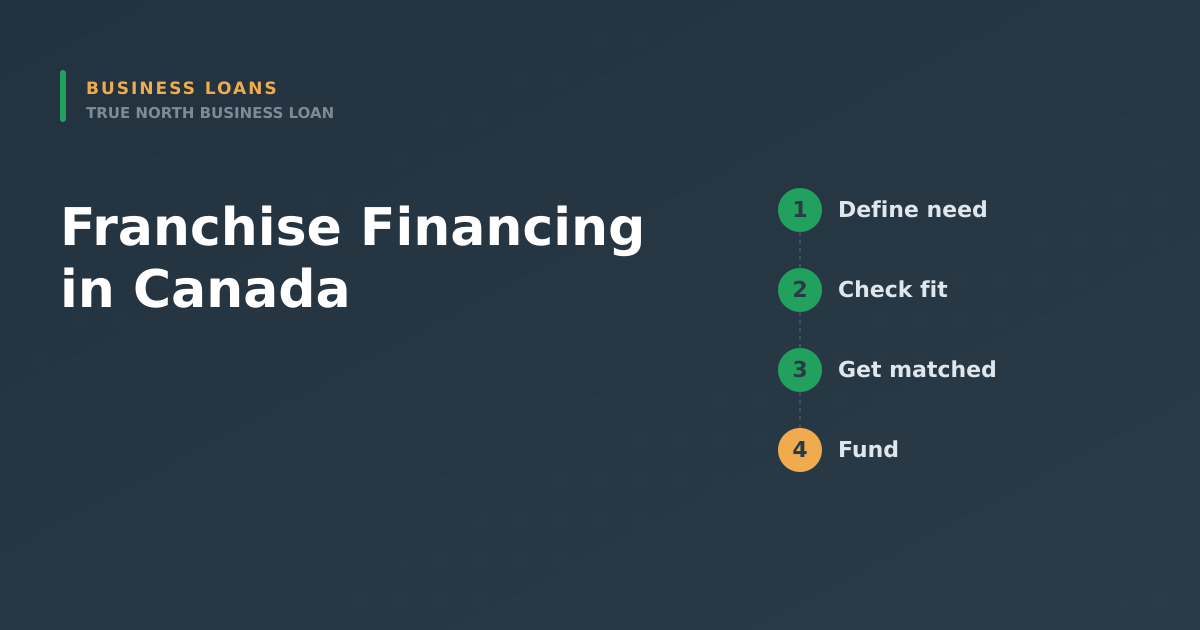
Franchise Financing in Canada: Funding an Established Franchise
Franchise financing in Canada enables franchisees to acquire, expand, or renovate existing franchise locations with structured debt solutions. Purchasing or growing an established franchise unit offers predictable historical cash flows, which makes securing capital significantly easier than funding an unproven startup.
What is franchise financing for Canadian operators?
Franchise financing is specialized business funding designed to cover the capital requirements of operating a franchised business model. It provides capital for working capital, mandated brand renovations, equipment upgrades, and multi-unit territory expansion. Canadian lenders evaluate these applications by reviewing both the borrower's background and the franchise brand track record.
Unlike independent small businesses, franchises operate under proven operational playbooks and nationwide brand recognition. This structured system provides commercial lenders with greater confidence in your revenue stability. Consequently, established franchise owners often secure flexible repayment terms and faster funding timelines than independent operators.
You can use this funding for several operational milestones. These include paying franchise transfer fees, financing inventory surges during peak retail seasons, or fulfilling mandatory five-year store refreshes. Accessing a dedicated small business loan ensures that your existing operational cash flow remains protected while you complete necessary capital expenditures.
How does funding an established location differ from a new franchise?
Financing an established franchise location relies heavily on verified historical financial statements rather than forward-looking projections. Lenders examine past balance sheets, corporate tax returns, and merchant processing statements to determine borrowing capacity. This historical proof reduces underwriting risk and accelerates loan approval times.
When opening a brand-new franchise unit, lenders demand extensive personal collateral and substantial liquid equity. Startup franchisees often wait months for federal loan approvals while underwriting committees scrutinize demographic studies. In contrast, an existing unit with consistent daily sales provides immediate data that lenders use to issue quick approvals.
Acquiring an existing location also involves unique transaction costs that require tailored funding structures. Buyers must account for franchisor transfer fees, immediate equipment upgrades, and short-term working capital needs during the operational transition. Having flexible financing options lined up allows prospective buyers to negotiate purchases confidently.
Which financing options work best for Canadian franchises?
Canadian franchise owners have access to multiple financing products depending on their specific capital requirements and timeline. Selecting the right loan structure depends on whether you are acquiring machinery, managing daily payroll gaps, or funding an acquisition.
Term loans provide a lump sum of capital with predictable fixed or variable payments over a set duration. These loans are ideal for purchasing an existing unit, buyout agreements, or large-scale store remodeling projects. For operators who need capital quickly, modern lending networks can approve terms in 24 to 48 hours.
Specialized equipment financing allows operators to acquire kitchen lines, digital point-of-sale systems, or delivery vehicles without tying up cash reserves. In this structure, the purchased machinery serves as the underlying collateral, reducing the need for additional personal assets.
| Financing Type | Best For | Speed to Fund | Collateral Needed |
|---|---|---|---|
| Term Business Loans | Acquisitions, expansions, major refits | 24 to 48 hours | Varies by lender |
| Equipment Financing | Kitchen gear, POS systems, company vehicles | 1 to 3 business days | Secured by equipment |
| Merchant Cash Advance | Seasonal inventory, urgent working capital | 24 to 48 hours | Future card receivables |
What do Canadian lenders look for in established franchise applicants?
Lenders evaluate your operational track record, unit-level profitability, and current debt obligations before extending franchise capital. Underwriters look for stable gross revenue trends over the trailing twelve months to confirm debt affordability. They also confirm that your location remains in good standing with the parent franchisor entity.
Personal credit scores remain a factor, but alternative commercial lenders place heavier emphasis on business cash flow. A location generating consistent monthly gross revenue can qualify for competitive capital even if your credit score is rebuilding. Lenders want clear evidence that daily operating margins can comfortably absorb scheduled loan payments.
Preparing your application documents in advance helps avoid preventable underwriting bottlenecks. Having clean financial records ready ensures that underwriters can issue firm offers without unnecessary delays.
- Six months of recent Canadian business bank statements.
- Current franchise agreement showing remaining term length.
- Year-to-date profit and loss statement and balance sheet.
- Government-issued identification and business registration details.
- Summary of planned capital usage and operational projections.
What common mistakes delay franchise loan approvals?
The most frequent error franchise operators make is waiting until liquidity becomes critically low before seeking capital. Approaching lenders under severe cash stress limits your available borrowing options and forces reactive decision-making. Securing growth funding while your revenue is strong ensures access to optimal repayment terms.
Another common misstep is failing to account for corporate franchisor approval timelines. Many franchisors require formal notice and financial vetting before permitting a transfer or major store overhaul. If your lender approves capital but your franchisor delays transfer paperwork, you risk incurring holding costs without operating income.
Franchisees also frequently apply to traditional institutional banks without checking alternative lender eligibility. Big banks often take four to eight weeks to review franchise packages, only to decline applications over minor ratio variances. Exploring a modern matched marketplace allows you to compare real options rapidly.
- Relying exclusively on traditional banks with lengthy underwriting cycles.
- Overlooking mandatory franchisor transfer fees and required remodel timelines.
- Submitting incomplete monthly bank statements or outdated financial records.
- Borrowing short-term capital for multi-year capital improvements.
How do you calculate debt service coverage for a franchise loan?
The Debt Service Coverage Ratio measures your franchise location cash flow relative to its annual debt obligations. Lenders use this formula to verify that your business earns sufficient operating profit to cover loan principal and interest payments. A higher ratio indicates stronger financial health and lower default risk.
To calculate this metric, divide your Net Operating Income by your total annual principal and interest payments. Most Canadian commercial lenders prefer a ratio of 1.25 or higher, meaning your net profit exceeds debt obligations by 25 percent. Maintaining a healthy ratio gives you headroom to handle unexpected supplier cost increases or temporary sales dips.
Reviewing your debt service capacity before applying allows you to select a realistic borrowing amount. You can evaluate your potential terms quickly through the True North loan estimator to identify structures that fit your current unit cash flow.
What are the steps to secure franchise financing in Canada?
Securing franchise capital follows an organized sequence from initial financial assessment to final fund disbursement. Following these steps systematically prevents delays and ensures you obtain funding tailored to your business model.
First, evaluate your exact capital requirement and identify whether you need long-term growth funds or short-term operational liquidity. Next, assemble your core financial documents, including bank statements and franchise compliance certificates. Presenting transparent, complete records upfront builds underwriter trust immediately.
Finally, submit your details through an efficient loan matching platform to receive qualified loan options from multiple Canadian lenders. Comparing offers based on funding speed, total cost of capital, and repayment flexibility lets you select the best fit for your store.
- Calculate your total funding need, including working capital cushions and brand fees.
- Gather your trailing bank statements, tax documents, and franchise agreement.
- Complete a 60-second online loan assessment to match with compatible Canadian lenders.
- Review customized loan offers, select your preferred terms, and receive funding in 24 to 48 hours.
Frequently asked questions about franchise financing in Canada
Here are concise answers to common questions Canadian operators ask about financing an established franchise location.
Can I get franchise financing with bad credit in Canada?
Yes, established franchise owners can qualify for financing with fair or rebuilding credit. Alternative commercial lenders focus primarily on your monthly business cash flow and historical revenue rather than personal credit scores alone.
How much capital can I borrow for an established franchise?
Canadian franchise operators can access business financing ranging from $5,000 to $800,000. The exact amount depends on your monthly gross revenue, existing debt service obligations, and overall business performance.
How fast can franchise loan funds be deposited into my account?
Alternative lending networks provide loan decisions within 24 to 48 hours of application submission. Once approved and contracts are signed, funds are typically deposited directly into your Canadian business bank account within one to two business days.
Can I use franchise financing to cover mandatory franchisor renovations?
Yes, franchise financing products can fund mandatory brand refreshes, interior remodels, point-of-sale upgrades, and new commercial kitchen equipment required by your corporate franchisor agreement.
Do I need to pledge personal real estate to secure a franchise loan?
Not always. While traditional bank loans frequently require personal real estate collateral, many alternative term loans and equipment financing structures use business assets or future revenue rather than personal property.
Ready to Get Started?
Use our Business Loan Estimator to see what financing options are available for your business.
Get My Loan Estimate