
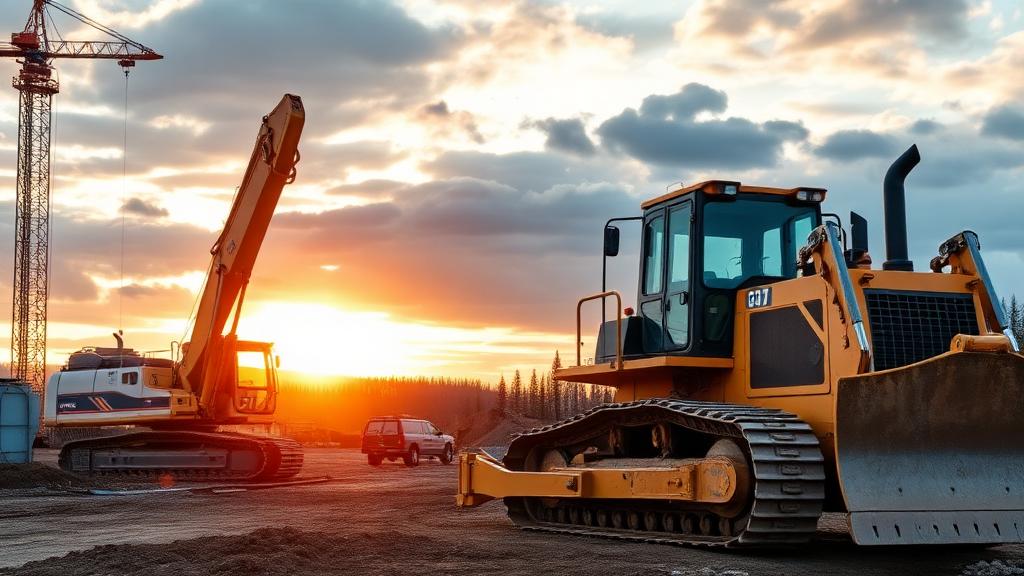
How to Finance Heavy Equipment for Your Construction Business in Alberta
Learn how Alberta construction businesses can finance heavy equipment through loans, leases, and government programs. Expert guide to equipment financing options, application requirements, and strategic decision-making.
For any construction business in Alberta, heavy equipment isn't just a tool—it's the engine of your enterprise. From excavators breaking ground on a new subdivision in Calgary to graders paving roads in the oil sands near Fort McMurray, the right machinery is essential for completing jobs on time and on budget. But this equipment represents a massive capital investment, and in Alberta's notoriously cyclical economy, tying up cash in large purchases isn't always the smartest move.
This is where strategic financing becomes a critical competitive advantage. Choosing the right financing structure allows you to acquire the equipment you need to grow while preserving the working capital required to manage payroll, buy materials, and navigate the industry's booms and busts. This guide will serve as your comprehensive roadmap to the equipment financing landscape in Alberta, breaking down your options and outlining exactly what lenders look for.
The Core Decision: To Buy, To Lease, or To Rent?
Before diving into financing products, it's important to understand the strategic choice you're making.
Renting is ideal for short-term needs or specialized equipment for a single job. It's the most expensive on a per-hour basis but offers zero long-term commitment.
Leasing functions as a long-term rental, typically spanning 2-5 years. You get the use of new or late-model equipment for a fixed monthly payment, often with maintenance included. It's great for preserving capital and having predictable costs.
Financing to own means you take out a loan to purchase the equipment. You build equity in the asset over time, and once paid off, it's yours. This is a long-term investment that makes sense for core pieces of machinery you will use for many years.
| Option | Best for | Trade-off |
|---|---|---|
| Rent | Short-term needs or specialised equipment for a single job | Most expensive per hour, but zero long-term commitment |
| Lease | Running newer equipment on predictable fixed payments, 2-5 years | Preserves capital; you don't build equity |
| Finance to own | Core machinery you'll use for many years | You build equity and own the asset outright |
This guide focuses on the latter two options: leasing and financing to own.
Your Key Financing Options in Alberta
When you decide to lease or buy, you have several avenues for funding. Each has its own pros, cons, and ideal use cases.
Heavy Equipment Loans
This is the most straightforward option. It functions like a traditional vehicle loan: a lender provides the capital to purchase a specific piece of equipment, and that piece of equipment serves as the collateral for the loan.
The process is simple. You receive a lump sum to buy the machinery. You then make regular principal and interest payments over a set term, typically 3 to 7 years. Once the loan is fully paid, you own the equipment outright.
Several types of institutions offer equipment loans. Major banks like RBC and BMO have dedicated equipment financing divisions. Alberta-based institutions like ATB Financial have deep roots in Alberta and a strong understanding of the local construction and energy sectors, often offering more personalized service. Specialized private lenders focus exclusively on heavy equipment and often have faster approval processes and more flexible criteria than banks.
Equipment Leasing
Leasing is an excellent strategy for preserving capital. Instead of owning the asset, you are paying for the right to use it for a set period.
With equipment leasing, you make fixed monthly lease payments for the duration of the term. At the end of the lease, you typically have several options: return the equipment, purchase it for its fair market value, or renew the lease.
A capital lease (or lease-to-own) is essentially a loan disguised as a lease. The payments are structured so that at the end of the term, you can purchase the equipment for a nominal amount, often just $1 or $10. It functions like an equipment loan but can sometimes have tax advantages.
An operating lease is a true lease where you are simply renting the equipment long-term. Payments are lower than a capital lease because you are only paying for the depreciation of the asset during the term, not its full value. This is ideal for businesses that want to operate a newer fleet and cycle out equipment every few years.
The Canada Small Business Financing Program
This government-backed program is a powerful tool for Alberta businesses. The CSBFP doesn't lend money directly but guarantees loans made by banks and credit unions, making it easier for small businesses to get approved for equipment financing up to $500,000.
The Canada Small Business Financing Program doesn't lend directly — it guarantees loans made by banks and credit unions, making approval easier for equipment financing up to $500,000.
The Application Process: What Alberta Lenders Look For
Lenders in Alberta are experienced with the construction industry's ups and downs. They will look for signs of stability and a clear plan.
Your business history and revenue matter significantly. Lenders want to see a stable track record, typically at least two years in business, with consistent revenue that demonstrates you can handle a new monthly payment.
A strong credit score is crucial for securing the best rates. Both your personal and business credit scores will be evaluated.
You will need to provide detailed information about the equipment, including a formal quote from the seller with the year, make, model, hours of use, and overall condition of the machinery.
Most lenders prefer to see a down payment of 10-20%. While some offer 100% financing, a down payment shows you have skin in the game and reduces the lender's risk.
Be prepared to explain how this new piece of equipment will help your business. Will it allow you to take on more contracts? Improve efficiency and reduce labour costs? A clear answer shows you've thought through the investment.
- Business history and revenue — typically at least two years operating, with consistent revenue
- Strong personal and business credit — both are evaluated and drive your rate
- A formal equipment quote — year, make, model, hours of use and condition
- A down payment of 10-20% — shows skin in the game and lowers the lender's risk
- A clear business case — how the machine wins more contracts or cuts labour costs
Conclusion: The Right Tool for the Job
In Alberta's demanding and competitive construction sector, having the right equipment is non-negotiable. By understanding the differences between equipment loans and leases and preparing a strong application, you can secure the financing you need. The right funding isn't just a loan; it's a strategic tool that empowers your business to build, grow, and thrive, no matter what the economic forecast holds.
Ready to Get Started?
Use our Business Loan Estimator to see what financing options are available for your business.
Get My Loan Estimate