
Manufacturing Equipment Loans: How to Finance Your Production Line
Manufacturing equipment loans allow Canadian business owners to acquire critical machinery without draining working capital. Financing ranges from $5,000 to $800,000 with approvals in 24 to 48 hours, using the machinery itself as collateral.
Scaling a manufacturing operation requires constant investment in machinery, technology, and facility infrastructure. Upgrading a production line can significantly increase throughput, reduce unit costs, and improve safety standards. However, purchasing heavy industrial machinery upfront requires substantial cash reserves that could otherwise fund daily operations.
Canadian manufacturers face unique cash flow dynamics. Long payment cycles from commercial buyers often coincide with immediate obligations for raw materials and payroll. Paying outright for expensive machinery can strain operational liquidity and expose a company to financial risk during market fluctuations.
Using tailored equipment financing programs allows shop owners to spread the cost of production machinery over its useful lifespan. This guide explains how equipment financing works, what lenders look for, and how to secure funding quickly.
What are manufacturing equipment loans in Canada?
Manufacturing equipment loans are asset-backed business financing solutions designed specifically to help Canadian companies acquire, upgrade, or replace machinery. Because the equipment serves as primary collateral, these loans often feature higher approval rates and simpler qualification rules than unsecured term loans.
Lenders evaluate both the financial health of your manufacturing business and the liquidation value of the machinery being purchased. If your company defaults, the lender can repossess and sell the equipment to recover remaining funds. This collateralized structure lowers the lender's risk profile significantly.
Funding amounts typically range from $5,000 to $800,000, catering to both small specialized workshops and large production facilities. Terms generally range from 24 to 72 months, aligning with the expected operational lifetime of the equipment. Monthly payments remain fixed, allowing plant managers to forecast operating expenses accurately.
Unlike traditional commercial mortgages or lines of credit, equipment loans are structured for speed and utility. Modern lending networks evaluate soft data and bank cash flow rather than relying solely on decades of corporate history. Approval decisions frequently take between 24 and 48 hours.
Why should Canadian manufacturers finance machinery instead of buying outright?
Financing production equipment preserves critical working capital for daily operational expenses. Buying expensive industrial machinery with cash depletes bank reserves, leaving your factory vulnerable to supply chain disruptions, urgent maintenance costs, or unexpected increases in raw material prices.
Maintaining strong cash reserves provides a vital buffer during economic shifts or seasonal lulls. By opting to finance machinery, your factory retains liquid capital to hire skilled operators, fulfill larger purchase orders, and cover inventory carrying costs. Preserving liquidity keeps your business agile and capable of handling contract spikes.
Tax benefits also play a major role in equipment financing decisions in Canada. Capital Cost Allowance rules allow businesses to write off equipment depreciation against taxable income over time. Additionally, interest paid on commercial business financing is generally tax-deductible as an operating expense.
Finally, financing helps prevent technological obsolescence. Production standards evolve rapidly with advances in automation and robotics. Structuring equipment agreements with manageable payment schedules allows shops to replace older machines with modern, high-efficiency models every few years without incurring massive capital hits.
What types of manufacturing machinery can you finance?
Equipment loans cover virtually any piece of physical machinery directly involved in manufacturing, processing, assembly, or material handling. Whether you run a precision machine shop, a food packaging facility, or an industrial textile plant, equipment lenders fund both new and refurbished machinery.
Financing applies to primary heavy machinery as well as essential supporting equipment. Lenders recognize that specialized auxiliary equipment, such as heavy-duty dust extraction systems or industrial chillers, is critical to maintaining continuous production operations.
Commonly financed manufacturing assets include:
- CNC machining centers, lathes, milling equipment, and automated cutting tools
- Industrial packaging lines, bottling systems, and automated shrink-wrapper machinery
- Injection molding units, extrusion lines, and industrial stamping presses
- Robotic arm assemblies, conveyor networks, and material handling systems
- Commercial metal fabrication units, welding stations, and plasma cutters
- Industrial ovens, food processing equipment, and stainless steel mixing tanks
Soft costs can often be bundled into the overall financing agreement. Soft costs include freight delivery charges, complex site installation, initial calibration, and staff training expenses. Including these peripheral costs in the overall loan prevents unexpected out-of-pocket expenses during installation.
How do you qualify for manufacturing equipment financing?
Qualifying for an equipment loan in Canada is generally more straightforward than securing an unsecured bank loan. Lenders rely heavily on the tangible value of the equipment to offset borrower risk. However, your business must still demonstrate consistent revenue and operational stability.
Most alternative commercial lenders require a minimum of 6 months in business and predictable monthly revenues. Lenders analyze bank statement cash flows to verify that your plant generates sufficient income to handle new fixed monthly debt obligations alongside existing overhead.
Credit history is evaluated, but a pristine score is rarely required. Lenders typically conduct a soft credit check during initial reviews, which does not impact your credit score. If your business demonstrates strong cash flows and the machinery holds solid resale value, lower credit scores can often be approved.
For faster approvals, you should prepare basic documentation ahead of time. Lenders typically request recent business bank statements, a formal equipment quote or purchase order from a vendor, and basic company identification. Clear documentation speeds up the review process significantly.
How do you apply for equipment financing step by step?
Applying for equipment loans should be a direct, streamlined process that does not delay your operational timelines. Following an organized application process ensures your factory secures funding before delivery schedules are finalized.
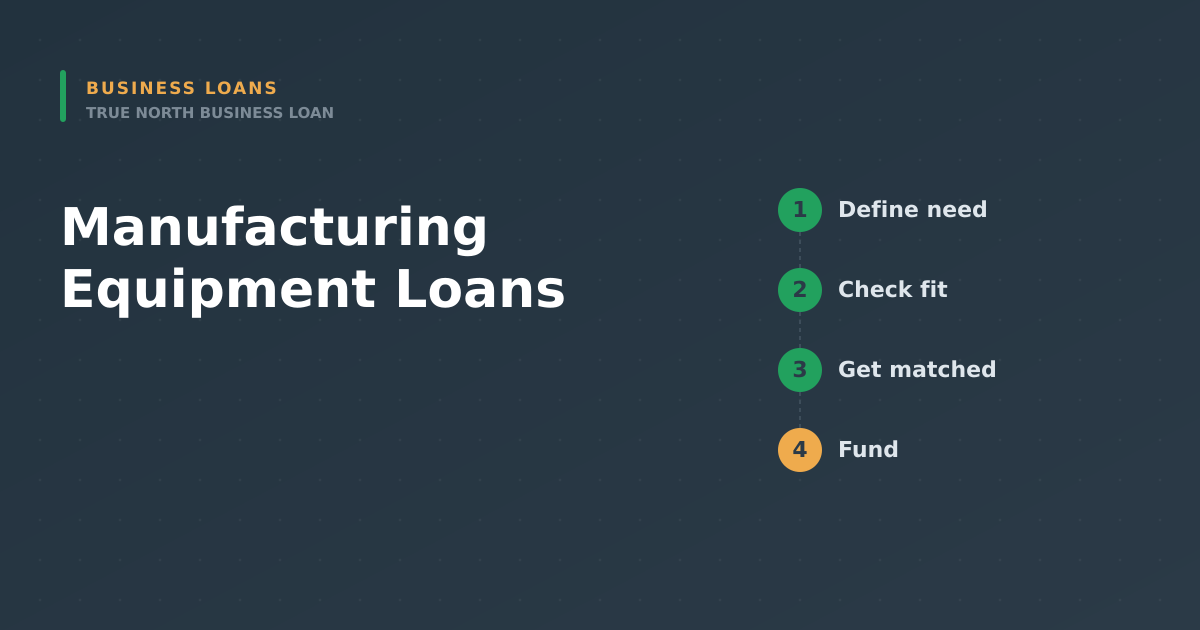
- Identify the exact machinery needed and secure an official invoice or quote from a certified equipment supplier.
- Complete a 60-second loan estimator online to submit basic business details without impacting your credit score.
- Review custom financing options matched to your factory's revenue profile and select the optimal repayment structure.
- Submit recent bank statements and the vendor quote to complete the formal approval process within 24 to 48 hours.
- Receive funds directly or have the lender pay the equipment vendor directly so your machinery can be delivered and installed.
Working through a matched lender network avoids the frustration of submitting multiple standalone applications. A single digital application connects your request with specialized equipment lenders competing for your business, increasing your overall odds of approval.
What pitfalls should you avoid when financing production equipment?
Navigating machinery financing requires careful attention to detail to avoid costly operational mistakes. Steering clear of common traps keeps your equipment investments profitable and protects your working capital over the long haul.
Failing to account for installation downtime is a frequent oversight for growing plants. Bringing a new production line online often requires factory floor alterations, electrical upgrades, and employee retraining. Ensure your business maintains enough cash flow during the setup window before full production yields start.
Another common mistake is choosing repayment terms that extend beyond the functional lifespan of the machinery. If a specialized machine becomes obsolete or requires major overhaul in four years, structuring a six-year loan leaves you paying for an uncompetitive asset.
- Ignoring soft costs: Forgetting to include shipping, installation, electrical retrofitting, and staff training in the total financed amount.
- Over-leveraging short-term cash flow: Selecting overly aggressive short repayment terms that strain monthly operating liquidity.
- Applying at multiple banks simultaneously: Triggering multiple hard credit pulls that reduce your credit score and flag risk to underwriters.
- Misjudging maintenance overhead: Overlooking scheduled maintenance costs required to keep machinery running at peak efficiency during the loan term.
Reviewing all agreement details ensures that loan terms match your production forecasts. Choosing the right financing structure keeps your plant agile and financially resilient throughout the equipment lifecycle.
How do traditional Canadian banks compare to online funding networks?
When seeking equipment loans, Canadian manufacturers typically choose between traditional chartered banks and specialized online funding networks. Both channels offer distinct characteristics depending on your urgency, business profile, and time in operation.
Traditional banks usually offer low interest rates, but their application requirements are exceptionally strict. Banks demand multiple years of audited financial statements, detailed business plans, and substantial collateral beyond the machinery itself. Approval processes at traditional banks frequently take four to eight weeks, which can cause you to miss supplier discounts or critical project deadlines.
Alternative lender networks focus on speed, flexibility, and accessible qualification logic. By analyzing real-time cash flow and equipment utility, digital platforms deliver conditional approvals within 24 to 48 hours. This efficiency makes alternative financing ideal for business owners needing quick machinery replacements or rapid capacity expansions.
| Feature | Traditional Canadian Banks | Alternative Lender Networks |
|---|---|---|
| Approval Speed | 4 to 8 weeks | 24 to 48 hours |
| Documentation Required | Audited statements, tax returns, business plans | Basic bank statements & vendor quote |
| Minimum Time in Business | 2+ years required | 6+ months eligible |
| Impact on Credit Score | Hard pull during initial review | Soft check for initial estimator |
| Approval Flexibility | Strict risk criteria; frequent rejections | High approval odds matched to cash flow |
If your manufacturing business has decades of operational history and can afford a lengthy waiting period, traditional banks remain an option. However, for manufacturers seeking fast turnaround times and flexible terms, working with a matched network of lenders provides superior speed and higher success rates.
How can you combine equipment financing with other business loan products?
Equipment loans cover physical machinery, but production expansion often requires auxiliary working capital. Scaling up output means buying extra raw materials, hiring additional machine operators, and handling larger inventory volumes before customer invoices are paid.
Many growing manufacturers pair equipment loans with short-term Canadian small business loans or working capital solutions. While the equipment loan handles the heavy capital expenditure, a working capital line covers inventory purchases and operator wages during the initial production ramp-up.
For manufacturers dealing with slow-paying commercial clients, invoice financing can also be integrated into the growth strategy. Unlocking capital tied up in unpaid customer receivables provides immediate cash flow to keep materials flowing into new production lines.
Using a comprehensive financing strategy prevents operational bottlenecks. By structuring your capital needs across purpose-built financing tools, your business can scale production capacity while maintaining healthy liquidity across every department.
Frequently asked questions about manufacturing equipment loans
Can I finance used or refurbished manufacturing machinery?
Yes, Canadian equipment loans can be used for both new and used machinery. Lenders evaluate the age, condition, and expected remaining lifespan of used equipment to determine appropriate loan terms and funding amounts.
How fast can I get approved for a manufacturing equipment loan?
Through True North's lender network, preliminary approvals are delivered in 24 to 48 hours. Once documentation is finalized, funding can occur in as little as one business day.
Does applying for an equipment loan estimator affect my credit score?
No, completing the initial loan estimator quiz requires only a soft credit check. Soft credit checks do not impact your credit score or leave visible inquiries on your credit report.
What is the maximum amount I can borrow for equipment financing?
Equipment loans through our network range from $5,000 up to $800,000, depending on your business revenues, time in operation, and the value of the machinery being acquired.
Can soft costs like delivery and installation be included in the loan?
Yes, many equipment lenders allow soft costs—including shipping, installation, calibration, and software setup—to be bundled directly into the total financed loan amount.
Ready to Get Started?
Use our Business Loan Estimator to see what financing options are available for your business.
Get My Loan Estimate