
Merchant Cash Advance in Canada: Costs, Pros, and When It Fits
What is a merchant cash advance in Canada?
A merchant cash advance in Canada is a financial arrangement where a funding provider purchases a specific portion of your business's future credit and debit card sales at a discount. In exchange for this purchase, your business receives an upfront lump sum of operating capital. Repayments are made automatically as a small percentage of your ongoing daily or weekly payment processing volume.
Unlike traditional term business loans, a merchant cash advance is technically not a loan. It is structured as an advance on future sales revenues under a commercial purchase contract. Because it is structured as a sales purchase rather than a loan, approval depends primarily on your consistent card transaction history rather than strict personal credit thresholds or physical asset collateral.
This structure provides Canadian small businesses with flexible financing that naturally scales alongside revenue shifts. During busy sales cycles, your repayment accelerates as revenue increases. During slower business periods, the dollar amount deducted decreases proportionately, helping protect your cash flow balance.
A merchant cash advance provides rapid capital based on future card sales rather than traditional credit scores or real estate collateral. Daily repayments automatically adjust with your sales volume.
For Canadian entrepreneurs seeking quick access to capital, exploring structured merchant cash advance options offers a viable pathway when conventional bank timelines do not match urgent operational needs.
How does a merchant cash advance work for Canadian payment flows?
A merchant cash advance works by integrating directly with your Canadian merchant payment processor or primary business bank account. Once funding is approved, the provider sets up an automated daily or weekly settlement process to retrieve an agreed percentage of your revenue until the full advance balance is repaid.
This daily percentage is commonly referred to as the retrieval rate or holdback rate. Retrieval rates typically range between 5% and 20% of your total card transactions, depending on your advance size, historical transaction stability, and estimated payback window. Your payment terminal automatically splits this percentage at the end of each business day, routing it directly to the funding provider.
Because the daily repayment dollar amount varies according to daily credit and debit card receipts, there is no fixed calendar end date for the agreement. If sales are strong, the advance is satisfied faster. If sales temporarily dip, the advance balance takes longer to fulfill without triggering default penalties or late fees.
- Match and estimate: Complete an online screening to review eligibility based on your average monthly card revenue and operational history.
- Verification: Provide recent payment processing statements and electronic bank records to establish your average transaction balance.
- Advance funding: Receive approval within 24 to 48 hours, with funding deposited directly into your Canadian business account.
- Automated payback: Settle the advance automatically through daily processing splits or electronic bank deductions as card sales occur.
This streamlined process eliminates the need to manually write cheques or manage recurring monthly transfer dates, allowing owners to focus fully on day-to-day operational execution.
How much does a merchant cash advance cost in Canada?
Merchant cash advance pricing in Canada does not use annual percentage rates or standard compounding interest. Instead, advance providers price capital using a metric known as a factor rate. A factor rate is a fixed decimal multiplier applied directly to the principal advance amount to calculate total repayment.
Factor rates across the Canadian commercial marketplace typically range between 1.10 and 1.40. To determine your total payback amount, you multiply the funding amount received by the factor rate quoted by the funder. For example, an advance of $30,000 evaluated at a 1.20 factor rate results in a total repayment amount of $36,000 ($30,000 principal plus $6,000 advance cost).
Total Repayment = Advance Amount x Factor Rate. For example, a $50,000 advance with a 1.25 factor rate equals $62,500 total payback, regardless of how quickly or slowly your sales settle the balance.
Because the factor cost is fixed from the day your contract begins, paying off an advance earlier than projected does not usually lower the total repayment cost. Unlike a conventional bank loan where early payment saves interest charges, an MCA cost remains constant because you agreed to sell a fixed dollar amount of future sales at a preset discount.
Understanding effective annual percentage rates (APR) on an MCA requires analyzing how fast the advance is cleared. A higher daily transaction volume shortens the payback duration, which increases the annualized cost rate despite keeping total dollar costs identical. Business owners must evaluate both total payback dollars and expected operational cash flow impact before committing.
What are the main advantages of a merchant cash advance?
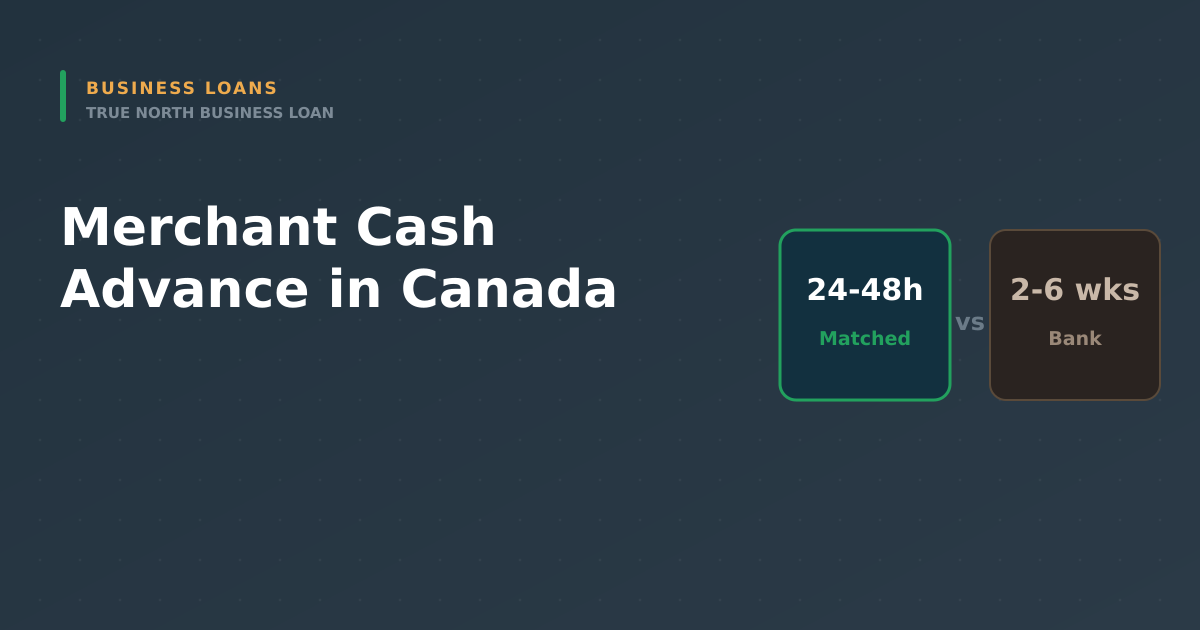
The principal advantage of a merchant cash advance lies in its rapid approval and funding velocity. Traditional Canadian financial institutions can require weeks or months to process commercial credit applications, inspect documentation, and issue decisions. MCA providers leverage digital data connections to issue decisions within 24 to 48 hours.
Another primary benefit is accessible qualification criteria. Because approval centers on historical card volume and operational consistency, business owners who may not meet strict bank credit thresholds can still secure capital. Funding parameters focus on your current revenue trajectory rather than historical personal credit challenges or missing tangible asset backing.
Flexible repayment schedules directly insulate retail, restaurant, and service businesses from cash flow crunches during slow operational cycles. Traditional term loans mandate fixed monthly cash outflows regardless of seasonal slumps. An MCA reduces your dollar outflow automatically on slow days, keeping your working capital baseline stable.
To evaluate potential capital fit without impacting your personal credit profile, business owners can complete a quick 60-second loan estimator to view matched financing options tailored to their specific revenue profile.
What are the potential drawbacks and risks of an MCA?
While merchant cash advances offer speed and flexibility, they come with explicit financial trade-offs that business owners must analyze carefully. The most prominent trade-off is the overall cost of capital, which is higher than secured bank debt or traditional commercial lines of credit.
Daily remittance requirements can also place persistent pressure on operational cash balance. Because a set percentage of daily card revenue is remitted before reaching your operating account, businesses operating on narrow profit margins may find daily expense management challenging.
- Working capital reduction: Daily holds reduce cash reserves available for routine overhead, supplier invoices, and administrative expenses.
- Fixed pricing limits: Paying off the advance early does not reduce the overall factor cost, limiting potential interest savings.
- Refinancing traps: Taking on additional advances to clear existing balances creates compounding debt obligations that threaten business stability.
To avoid cash flow strain, an advance should be paired with specific high-return business opportunities or short-term emergency needs rather than utilized as continuous funding for ongoing structural losses.
Who qualifies for a merchant cash advance in Canada?
Qualification criteria for a merchant cash advance in Canada center primarily on sales consistency, processing method, and operational tenure. Providers focus on businesses that handle high volumes of customer payment transactions regularly.
Most Canadian MCA providers require a minimum operational history of six months in business. Newer businesses with consistent daily transaction records are frequently considered, whereas conventional business lenders often require at least two years of audited financial statements.
- At least 6 months of continuous business operations in Canada
- Consistent monthly card transaction volume ($5,000 or more)
- An active Canadian commercial bank account
- No active open bankruptcies or unresolvable legal judgments
Industries that process substantial debit and credit card payments daily represent ideal fits for this product structure. Common sectors include retail storefronts, restaurants, medical practices, automotive repair shops, salons, and e-commerce platforms across all Canadian provinces.
When does a merchant cash advance fit your business best?
A merchant cash advance fits your business best when speed is paramount and the immediate return on capital exceeds the fixed factor cost of funding. Using high-cost capital for routine operating losses is risky, but deploying it to capture time-sensitive revenue opportunities often makes economic sense.
One clear scenario is bulk inventory purchasing ahead of peak consumer seasons. If a retail business can secure substantial vendor discounts by placing a large upfront inventory order, the revenue margin gained from those sales often far outweighs the factor rate fee paid on the advance.
Another common use case involves critical equipment repairs or emergency replacements. If a key commercial oven, vehicle, or point-of-sale terminal breaks down, waiting weeks for conventional bank loan processing halts revenue generation. Accessing fast funds preserves operational continuity and protects ongoing income streams.
Finally, cash advances serve as effective bridges during rapid growth phases. When opening a second location or fulfilling a sudden order spike requires immediate working capital, access to funding within 24 to 48 hours allows business owners to capture expansion opportunities without missing critical delivery deadlines.
What alternative funding options should you consider first?
Before committing to a merchant cash advance, Canadian business owners should review alternative financing structures to ensure they choose the product with the lowest total cost and best cash flow fit.
Unsecured small business loans offer predictable weekly or monthly amortized schedules. They are structured with fixed or variable interest rates and set terms ranging from 6 to 36 months, making long-term budgeting easier for businesses with stable monthly income.
If capital is needed specifically to acquire physical tools, machinery, or commercial vehicles, reviewing equipment financing options is recommended. Equipment loans use the acquired asset itself as collateral, which typically yields lower borrowing costs and longer repayment terms than an advance.
For business-to-business (B2B) operations with capital tied up in unpaid customer invoices, invoice factoring presents an effective solution. Factoring advances cash against outstanding accounts receivable, allowing businesses to unlock tied-up working capital without relying on consumer debit or credit card processing flows.
To understand how different financing structures compare across timing, costs, and qualification requirements, review our detailed guide on how business loan matching works.
Frequently asked questions about merchant cash advances in Canada
Will applying for a merchant cash advance impact my credit score?
Initial evaluations with True North use a soft credit check process, which does not impact your credit score. If you choose to accept a lender offer, a hard credit inquiry may occur during final document verification.
How fast can funding be deposited into my business account?
Once approved and verified, funding is typically deposited into your Canadian business bank account within 24 to 48 hours, often in as little as one business day.
Can I qualify for an MCA if I have bad personal credit?
Yes, business owners with lower personal credit scores can still qualify. MCA providers focus primarily on your monthly card revenue volume and overall business cash flow consistency rather than personal credit scores.
How is a merchant cash advance different from a standard business loan?
A business loan provides capital repaid via fixed scheduled payments over a set term with annual interest rates. An MCA is a commercial purchase of future receivables repaid automatically via a variable percentage of daily card sales based on a factor rate.
Can I pay off my merchant cash advance early to lower the cost?
In most cases, early repayment does not lower the overall cost because factor rates fix the total payback dollar amount at the start of the contract, though some lenders offer early payoff discounts.
Ready to Get Started?
Use our Business Loan Estimator to see what financing options are available for your business.
Get My Loan Estimate