
Refinancing Business Debt in Canada: When It Helps and When It Hurts
What is business debt refinancing and how does it work in Canada?
Business debt refinancing replaces one or more existing business loans with a single new loan under revised repayment terms. This financial strategy usually aims to reduce interest costs, lower daily cash outflow, or consolidate multiple daily or weekly debt payments into one predictable remittance.
When a business owner refinances debt in Canada, the newly issued capital pays off existing balances across short-term lenders, high-interest credit lines, or merchant cash advances. The business then makes repayments to the new lender based on an updated schedule and structure. Depending on company performance and revenue stability, this transition can free up operational working capital.
Canadian small businesses often use refinancing when their financial standing improves relative to when they first took on capital. If your business has increased its monthly gross revenue or built a stronger credit profile over the past 6 to 12 months, refinancing can unlock terms that were unavailable during earlier operating stages.
Refinancing business debt replaces existing high-cost liabilities with a single new facility. It works best when used to lower total borrowing costs or simplify debt management, rather than to cover ongoing operational shortfalls.
When does refinancing business debt make financial sense?
Refinancing business debt makes sense when the replacement loan significantly reduces your weighted cost of capital or relieves severe daily cash flow pressure. It creates real financial value when the total cost of the new loan, including all processing fees, remains lower than the total remaining cost of your existing obligations.
Many Canadian business owners accumulate multiple short-term financing products during periods of rapid growth or unexpected cash crunches. While these fast funds solve immediate needs, managing multiple daily or weekly micro-debits can strain daily cash reserves. Consolidating these obligations through structured small business loans restores predictable monthly budgeting.
Refinancing also works well when your business qualifies for a product upgrade. For instance, replacing a high-frequency merchant cash advance balance with a fixed-term facility stabilizes cash flow. This strategy allows working capital to remain in your primary operating account where it can support inventory purchases or payroll needs.
- Your business credit score or monthly revenue has improved since taking out original debt.
- You are currently managing multiple high-frequency debt payments every week.
- The weighted interest rate on new funding options is lower than your current average rate.
- You need to convert short-term, volatile obligations into predictable fixed payments.
When can refinancing business debt harm your company?
Refinancing business debt harms your company if it extends repayment terms so far that total interest charges exceed your current debt obligations. It also increases financial risk if prepayment penalties on your existing loans outweigh any calculated interest savings from the replacement loan.
One common pitfall is focusing exclusively on reducing the weekly or monthly payment amount while ignoring the total amortization cost. Extending a loan term from 6 months to 36 months will reduce immediate cash strain, but it can significantly increase total borrowing costs over time. Business owners must evaluate both the short-term cash flow impact and the long-term debt cost.
Another danger occurs when refinancing is used to mask underlying operational unprofitable trends. If your business consistently operates at a structural deficit, taking on a new consolidation loan only increases total indebtedness. Debt restructuring must accompany operational adjustments that fix root cash flow issues.
- Extending loan payback terms so far that cumulative interest payments balloon significantly.
- Ignoring early repayment penalty fees charged by existing Canadian commercial lenders.
- Refinancing short-term working capital needs into long-term collateralized obligations.
- Consolidating debt without correcting underlying operational profit margin deficits.
Which business loan products are best for debt consolidation?
Term loans and structured revenue-based loans are generally the most effective products for consolidating business debt. They provide clear repayment schedules, defined maturity dates, and predictable repayment amounts that simplify financial forecasting for Canadian business owners.
Selecting the right product depends on your company balance sheet, sales consistency, and available assets. A business with steady monthly revenue and at least 6 months in operation can secure funds ranging from $5,000 to $800,000 to clear multiple high-cost liabilities. Matching the funding product to your revenue model prevents future cash flow bottlenecks.
The table below highlights how common Canadian business financing options compare when used specifically for debt consolidation purposes.
| Loan Type | Consolidation Fit | Repayment Structure | Best Used For |
|---|---|---|---|
| Term Business Loans | High | Fixed monthly or bi-weekly | Consolidating multiple short-term loans |
| Merchant Cash Advance | Low | Daily percentage of card sales | Bridging temporary cash flow gaps only |
| Equipment Financing | Medium | Fixed monthly amortized schedule | Refinancing asset-backed machinery loans |
How do you calculate the true cost of refinancing your debt?
Calculating the true cost of refinancing requires comparing the total remaining payback amount of your current debt against the principal, interest, and fees of the new loan facility. You must account for prepayment costs, origination fees, and processing charges to find the net financial benefit.
Start by requesting official payoff statements from all your existing commercial lenders. These statements outline the exact cost required to close out your accounts today, including any early payoff penalties. Next, review the complete fee schedule of the proposed replacement facility, focusing on origination fees that are often deducted from initial funding proceeds.
If the combined payoff balances and new origination costs are less than the total outstanding payments remaining on your original debt schedule, refinancing delivers a net positive return. Always perform this calculation before signing new loan documentation.
Net Savings = (Remaining Total Payments on Current Debt) - (New Loan Principal + Total New Interest + Origination Fees + Prepayment Penalties). If Net Savings is greater than zero, refinancing is financially advantageous.
What do Canadian lenders evaluate when you apply for refinancing?
Canadian lenders evaluate your average monthly revenue, time in business, bank account cash flow trends, and existing debt service ratios when reviewing a refinancing request. They focus primarily on whether your current cash flow can comfortably support the proposed new payment structure.
Lenders look closely at your business bank account statements from the past 3 to 6 months. They track your daily cash balances, the frequency of non-sufficient funds events, and overall monthly sales consistency. A steady flow of operating deposits demonstrates that your business generates enough revenue to maintain regular debt service without operational disruption.
Your personal and business credit history also plays a key role during the matching process. While traditional bank channels require pristine credit, modern Canadian funding networks accommodate a broader range of credit profiles. Checking your options using a 60-second loan estimator allows you to review matched lender terms through a soft credit check that does not impact your credit score.
How do you prepare your business for a debt refinancing application?
Preparing for a debt refinancing application requires gathering recent financial documentation, calculating your total outstanding debt obligations, and clarifying your target monthly payment amount. Organizing these items beforehand accelerates approval decisions and funding timelines.
Begin by compiling your last 3 to 6 months of official business bank statements. Locate all current credit agreements, daily payment balance reports, and payoff quotes from active lenders. Having exact payoff figures prevents underestimating the total funding amount required to clear all targeted liabilities in full.
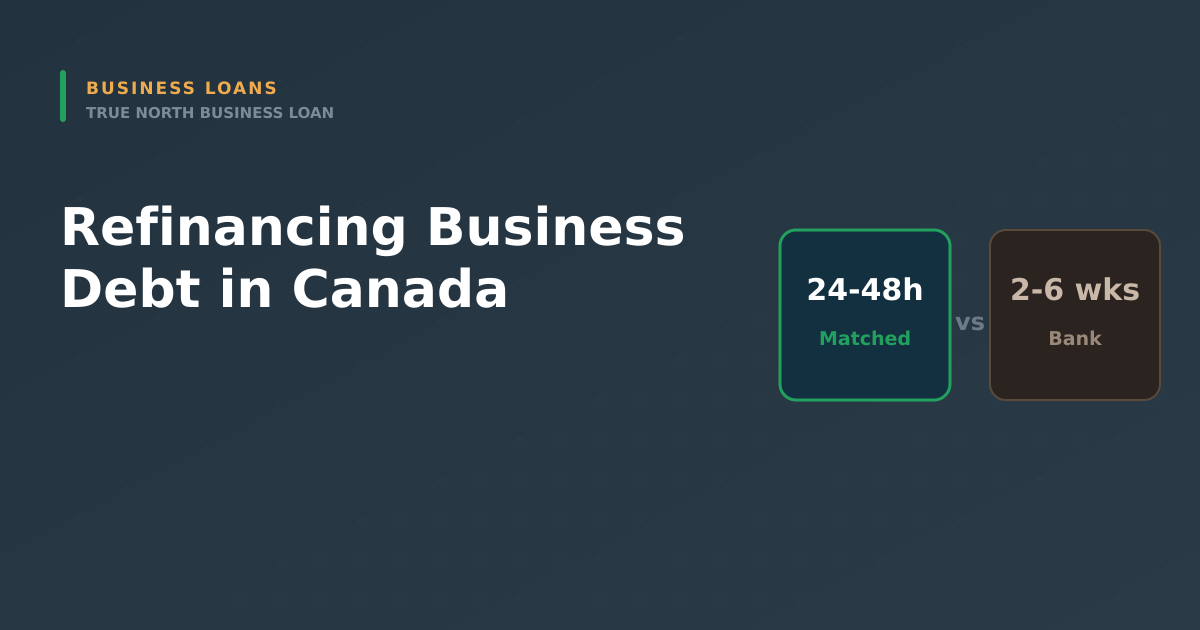
Once your documents are in order, submit your details through a matched lender network rather than applying individually to single institutions. Submitting multiple individual loan applications can trigger several hard credit pulls, which negatively affects your credit score. A matched platform submits your profile once, securing competitive offers from $5,000 to $800,000 with potential approvals within 24 to 48 hours.
What frequently asked questions do Canadian business owners have about debt refinancing?
Does applying to refinance business debt hurt my credit score in Canada?
Initial evaluations with matched platforms rely on soft credit checks, which do not impact your credit score. Hard credit inquiries only occur when you finalize a formal loan agreement with a selected lender.
How fast can a business debt refinancing loan be approved and funded?
Approvals typically take between 24 and 48 hours once complete bank statements are submitted. Funding can occur within one business day following contract completion.
Can I refinance high-cost merchant cash advances into a term loan?
Yes, consolidating high-frequency merchant cash advances into a single fixed-term business loan is one of the most common applications for business debt refinancing in Canada.
What is the minimum operating history required to refinance debt in Canada?
Most alternative commercial funding networks require a minimum of 6 months in operation alongside consistent monthly gross revenue trends.
Are there tax implications when refinancing business debt in Canada?
Interest paid on commercial business loans used for business operations is generally tax-deductible in Canada. However, principal repayments are not deductible. Consult a qualified Canadian accounting professional for specific tax guidance.
Ready to Get Started?
Use our Business Loan Estimator to see what financing options are available for your business.
Get My Loan Estimate