
Restaurant Business Loans in Canada: What Lenders Look For
Securing capital for a Canadian restaurant requires an understanding of how commercial lenders evaluate risk in the hospitality sector. Canadian lenders evaluate restaurant loan applications by focusing on consistent daily cash flow, debt coverage ratios, time in operation, and credit history. Because restaurants face high operating overhead and narrow margins, lenders prioritize predictable revenue over collateral.
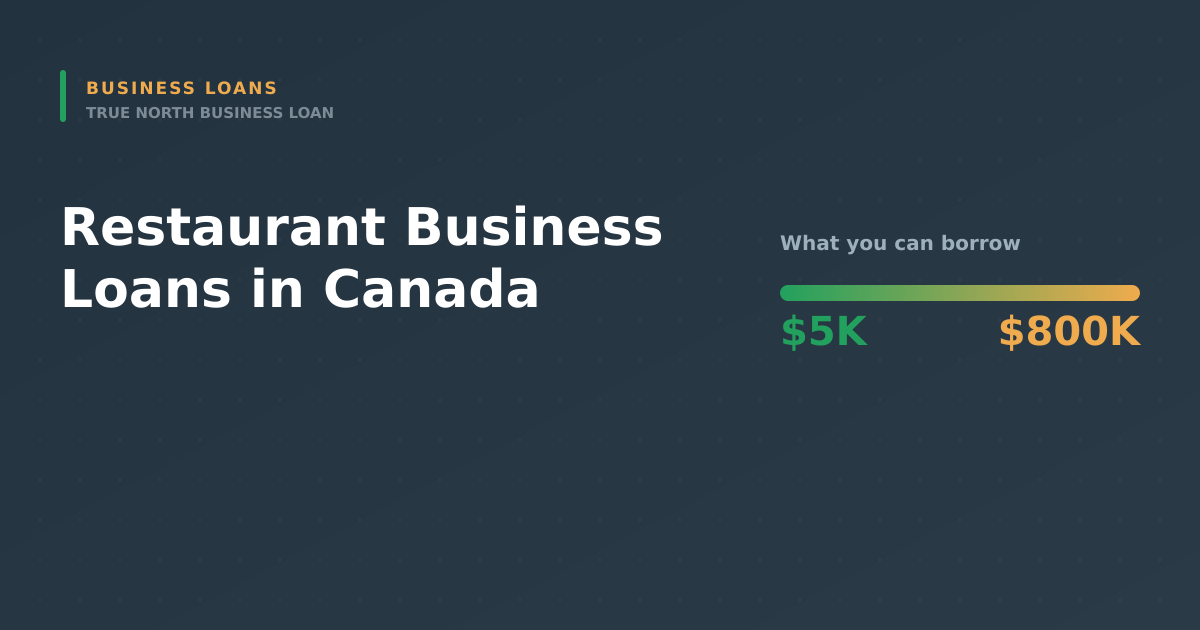
Canadian lenders assess restaurant financing based on daily bank deposits, minimum operating history, and cash flow consistency rather than physical assets alone. Knowing these benchmarks helps owners qualify for financing between $5,000 and $800,000.
What do Canadian lenders look for in restaurant loan applications?
Lenders evaluate restaurant applications primarily through financial consistency, bank statement health, and operational stability. Unlike traditional real estate or corporate lending, food service businesses rarely hold large tangible assets for collateral. Consequently, underwriters focus heavily on your business bank account activity to ensure steady customer cash flow.
Underwriters look at the volume and frequency of daily deposits coming into your account. A restaurant that generates consistent daily credit card sales presents significantly lower risk than one with erratic revenue spikes. Lenders want reassurance that your cash balance remains positive after paying payroll, suppliers, and food distributor invoices.
Furthermore, lenders review your operating history to measure business resilience. Establishments with at least six months of continuous operations demonstrate proven local demand and baseline viability. Understanding these foundational lending criteria helps you position your restaurant effectively before submitting an application.
How do lenders evaluate restaurant daily cash flow and revenue?
Lenders examine daily bank deposits and merchant processor statements to confirm steady cash influx across weekdays and weekends. They measure cash flow predictability to verify that your restaurant can manage recurring loan payments without squeezing daily inventory budgets. Smooth, recurring sales figures demonstrate that your location handles routine operating costs comfortably.
Food service businesses rely heavily on merchant card processing records. Underwriters analyze monthly sales totals alongside transaction frequency to calculate your average ticket size. High customer volume across debit and credit card payments indicates stable patronage and reliable daily revenue streams.
Seasonal fluctuations in Canada also play a major role in cash flow analysis. Patio season might bring high revenue in summer months, while winter months could experience lower foot traffic. Lenders want to see that your restaurant maintains sufficient reserve cash during off-peak periods to handle debt obligations without interruption.
Maintaining healthy average daily account balances is equally vital. Even if monthly revenue appears high, suffering frequent near-zero balances suggests cash management stress. Keeping a clean bank balance protects your financing eligibility when applying for working capital.
Why is your time in business critical for restaurant financing?
Time in business demonstrates operational resilience through seasonal shifts and changing local market conditions. Canadian lenders typically require a minimum of six months in business for alternative financing, while traditional banks often demand two full years of operating history. A longer operational track record proves that your management team understands cost controls and inventory control.
Newer restaurants inherently face higher statistical risks during their initial startup phase. During the first few months, dining concepts adjust menus, manage food waste, and establish supplier relationships. As a result, commercial lenders view operating track records as proof of sustainable unit economics.
For locations operating between six and twenty-four months, alternative lending pathways offer accessible funding options. These options focus on recent monthly revenue performance rather than multi-year corporate tax filings. Demonstrating strong trailing performance opens doors to fast capital without waiting years for bank approval.
If your restaurant has operated successfully for multiple years, lenders reward that track record with higher capital limits. Established establishments can secure funding up to $800,000 to open secondary locations, expand patio seating, or execute major dining room renovations.
What financial documents are required for a Canadian restaurant loan?
To apply for restaurant financing in Canada, you usually need three to six months of business bank statements, merchant processing records, and basic business identification. Preparing these documents in advance accelerates underwriting and leads to faster decision times. Modern alternative lenders utilize digital statement verification to speed up reviews without requiring physical paperwork.
Bank statements provide direct visibility into operating revenue, recurring expenses, and cash buffers. Underwriters review these statements to verify that claimed revenue matches actual bank deposits. Ensuring your accounts are clean of excessive transfers or non-sufficient fund events improves your approval odds.
Merchant processing statements offer insight into customer payment methods and card settlement flows. For restaurants seeking sales-based repayment structures, clear processor records confirm daily sales velocity. Complete documentation allows underwriters to provide firm funding offers within 24 to 48 hours.
- Three to six months of official Canadian business bank statements
- Point-of-sale (POS) and credit card processing reports
- Government photo ID and business registration proof
- Void cheque or pre-authorized debit details for funding
Having organized financial records streamlines the entire funding process. When documents are ready, underwriters can assess cash margins and finalize loan approvals rapidly.
How does debt service coverage impact approval odds?
Debt service coverage measures how easily your monthly operating profit covers existing and proposed debt obligations. A higher ratio indicates a healthy cash margin, proving your restaurant can handle financing payments even during slower dining months. Underwriters calculate this metric to ensure new loan payments will not jeopardize your business operations.
To evaluate your coverage, lenders compare net operating income against total monthly debt payments. If a restaurant generates $15,000 in monthly net profit and carries $10,000 in existing obligations, its coverage ratio is 1.5x. A buffer of this scale reassures underwriters that your business can comfortably service added financing.
| Debt Service Coverage Ratio | Lender Risk Assessment | Approval Likelihood |
|---|---|---|
| Under 1.0x | High Risk (Negative cash flow margin) | Low |
| 1.1x to 1.25x | Moderate Risk (Tight cash buffer) | Moderate |
| 1.3x or higher | Low Risk (Healthy operating surplus) | High |
If your ratio falls near 1.0x, added loan obligations could strain daily operations. In such cases, securing structured funding options designed around actual sales volume helps keep debt payments aligned with revenue.
What loan products work best for Canadian food service businesses?
The optimal loan product depends on your specific operational needs, such as buying kitchen equipment, funding renovations, or stabilizing cash flow. Canadian restaurant owners commonly choose term loans, merchant advances, and equipment financing depending on their growth phase. Selecting the right structure prevents cash flow strain while maximizing your return on capital.
For predictable monthly capital needs, traditional small business loans deliver fixed repayment terms and structured amortization. These term options work well for planned expansions, marketing pushes, or leasing additional commercial space. They provide clear payment schedules that integrate seamlessly into monthly accounting software.
When purchasing costly kitchen hardware, specialized equipment financing offers direct funding secured by the machinery itself. Whether replacing commercial walk-in freezers, combi ovens, or automated POS hardware, equipment loans preserve working capital. The equipment acts as underlying security, often allowing for flexible credit requirements.
For restaurants with heavy credit card sales, a flexible merchant cash advance aligns repayments directly with daily card settlements. During busy weekend rushes, repayments adjust dynamically based on volume, easing off during quieter weekdays. Business owners can complete a 60-second loan estimator to compare these flexible funding choices tailored to their location.
What common red flags lead to restaurant loan rejections?
Lenders reject restaurant loan applications primarily due to frequent overdrafts, tax arrears, declining monthly revenue, and undisclosed existing business loans. Identifying and fixing these issues prior to applying significantly increases your approval rate. Addressing operational concerns beforehand prevents unnecessary rejections and preserves your borrowing profile.
Frequent non-sufficient funds (NSF) charges indicate ongoing cash flow distress. When underwriters see multiple NSF fees on recent bank statements, it signals that the business struggles to meet basic operating commitments. Cleaning up account balances for thirty to sixty days prior to applying removes this red flag.
- Frequent non-sufficient funds (NSF) fees or bank account overdrafts
- Unresolved CRA tax debts or outstanding payroll source deductions
- Rapidly declining sales volume over consecutive trailing months
- Stacking multiple undisclosed daily or weekly business cash advances
Tax arrears with Canada Revenue Agency (CRA), particularly unpaid HST or GST payroll deductions, present serious obstacles to financing. Lenders require assurance that tax obligations are current or managed under official payment arrangements. Clearing government tax debts ensures smooth loan approval across funding partners.
Frequently asked questions about Canadian restaurant loans
Can I get a restaurant loan in Canada with bad credit?
Yes, alternative lenders focus heavily on your restaurant's cash flow and daily revenue rather than personal credit alone. While credit score is considered, strong card sales can help secure approval.
How fast can a restaurant receive funding in Canada?
Approvals typically take between 24 and 48 hours after submitted bank records are reviewed. Once approved, funds are direct deposited into your business bank account within one business day.
How much capital can my restaurant borrow?
Canadian food service businesses can secure business loan amounts ranging from $5,000 to $800,000 based on average monthly sales, time in business, and overall cash flow balance.
Does applying for a restaurant loan estimator affect my credit score?
Evaluating your options using a soft credit check does not impact your credit score. Hard credit pulls only occur when finalizing formal funding contracts.
Can I use restaurant loan funds to purchase new kitchen equipment?
Yes, business loan proceeds can cover specialized commercial kitchen equipment, dining room upgrades, inventory purchases, or marketing campaigns.
Ready to Get Started?
Use our Business Loan Estimator to see what financing options are available for your business.
Get My Loan Estimate