
Trucking Business Loans: Financing Trucks, Trailers and Fuel
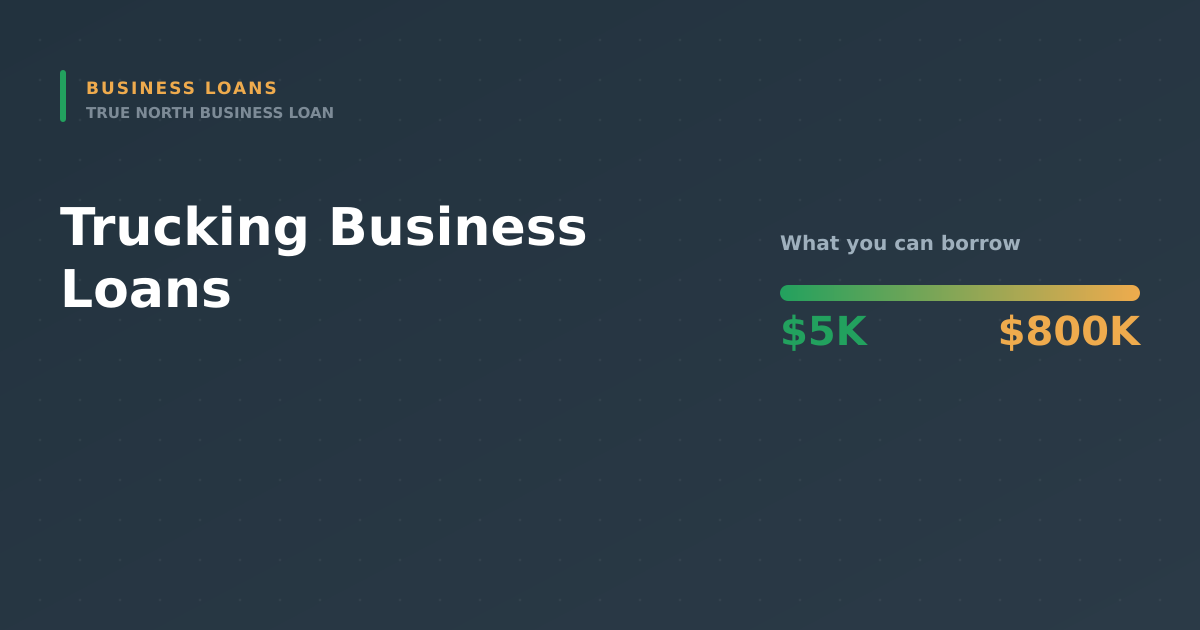
Trucking business loans provide Canadian owner-operators and fleet managers with the capital required to buy trucks, replace trailers, cover diesel fuel, and survive 30-to-90-day payment terms. Through True North, Canadian transport companies can secure $5,000 to $800,000 in funding with approvals in 24 to 48 hours and money in their account within one business day.
Canadian trucking businesses can access $5,000 to $800,000 through tailored equipment financing, term loans, or invoice factoring. Using a 60-second quiz allows you to explore multiple lender options with a soft credit check, securing approvals in 24 to 48 hours without risking bank delays or damaging your credit score.
What are trucking business loans and how do they work in Canada?
Trucking business loans are specialized commercial financing options designed to address the high operational costs and irregular cash flow cycles of Canadian transportation companies. These loans provide working capital or asset-based funding to cover heavy equipment purchases, trailer upgrades, routine maintenance, emergency repairs, and daily fuel expenses across provincial boundaries.
Unlike standard personal financing, commercial transport loans evaluate both personal credit and the operational revenue of your motor carrier operations. Canadian lenders look closely at your monthly gross revenue, years in business, contract stability, and fleet capacity to determine your borrowing limits and repayment terms. Depending on your immediate needs, capital can be delivered as a lump-sum equipment loan, a flexible working capital facility, or an advance against outstanding freight invoices.
For small transport operators, obtaining traditional bank financing can be challenging due to strict lending criteria, slow approval timelines, and strict collateral requirements. Specialized non-bank lending networks match your business profile with lenders that understand the commercial trucking sector, processing approvals within 24 to 48 hours and delivering funds directly to your Canadian business bank account.
Which funding option is best for your transport operational needs?
The ideal funding option depends directly on whether you need to purchase an asset, cover daily fuel costs, or bridge cash flow gaps caused by delayed shipper payments. Matching your financial instrument to your specific business requirement prevents overpaying on interest and keeps your balance sheet healthy.
| Financing Option | Best Primary Use Case | Approval Speed & Key Feature |
|---|---|---|
| Equipment Financing | Buying new or used trucks, semi-rigs, and trailers | 24–48 hours; asset acts as collateral |
| Invoice Factoring | Bridging 30–90 day broker payment delays | 24–48 hours; advances on unpaid loads |
| Small Business Term Loan | Major expansion, fleet overhauls, bulk repairs | 24–48 hours; predictable fixed monthly terms |
| Merchant Cash Advance | Emergency road repairs and immediate fuel cash flow | 24 hours; repaid from daily/weekly revenue |
Equipment financing works best for buying semi-trucks, dry vans, or refrigerated trailers because the equipment serves as collateral. Term loans offer lump-sum capital for major fleet upgrades, facility expansion, or multi-vehicle overhauls. Invoice factoring provides immediate cash based on unpaid bills, while merchant cash advances suit short-term working capital needs when invoice volume is low.
Evaluating these options requires analyzing your carrier's current cash conversion cycle. For example, if your primary challenge is waiting 60 days for freight brokers to settle invoices, advancing capital against receivables resolves operational cash crunches far more efficiently than taking on long-term debt.
How can equipment financing cover new and used trucks or trailers?
Equipment financing allows Canadian motor carriers to buy or lease new and used semi-trucks, flatbeds, dry vans, and specialized trailers without draining operational cash reserves. Under this structure, the vehicle or trailer itself acts as the primary loan collateral, which reduces risk for the lender and often leads to more favorable approval terms.
When applying for equipment financing in Canada, lenders evaluate the age, mileage, and condition of the truck or trailer alongside your business's financial health. Most lenders will finance up to 100 percent of the asset's value, though older units or non-standard equipment may require a modest down payment. This arrangement allows fleet owners to expand operational capacity, replace aging units before heavy maintenance costs accumulate, and meet strict provincial safety and environmental standards.
Furthermore, collateral-backed financing protects your existing business lines of credit and liquid cash. By spreading the capital cost of expensive transport assets over a multi-year term, your monthly payments remain predictable, allowing you to align equipment debt directly with the revenue generated by that specific rig on the road.
How does invoice factoring solve cash flow gaps from delayed freight payments?
Invoice factoring solves cash flow delays by advancing up to 90 percent or more of your unpaid freight bill value immediately after you deliver a load. Instead of waiting 30, 60, or 90 days for shippers or freight brokers to pay, your business receives working capital within 24 hours of submitting the bill of lading.
In the Canadian transportation sector, delayed payments from brokers can cripple daily operations, making it difficult to pay drivers, purchase fuel, or stay current on provincial taxes and insurance premiums. Invoice factoring turns your accounts receivable into predictable cash flow. When the broker eventually settles the bill, the factor releases the remaining balance minus a transparent fee for handling the transaction.
Because factoring relies primarily on the creditworthiness of your shippers rather than your business's credit history, it is an accessible option for newer carriers or businesses recovering from credit setbacks. Utilizing specialized invoice factoring helps haulers maintain continuous operational momentum without taking on traditional bank debt.
What do Canadian lenders require to qualify for transport financing?
To qualify for transport financing in Canada, carriers must typically demonstrate at least six months of active operations and generate consistent monthly gross revenue. Lenders review basic operational, financial, and regulatory documents to assess your ability to manage debt payments safely.
- Active Canadian business registration and minimum 6 months in operation
- Minimum $10,000 in monthly gross revenue backed by official bank statements
- Valid commercial driver's license (Class 1 or AZ) or operating authority documentation
- Active Safety Fitness Certificate and clean provincial carrier profile (e.g., CVOR)
- Proof of valid commercial vehicle auto and cargo insurance coverage
Having these documents organized speeds up the application process and increases your chances of securing competitive terms. Lenders evaluate bank statements to confirm cash flow consistency and verify that your bank account balance remains positive throughout the month, demonstrating sound cash management.
While traditional banks demand years of profitable tax returns and immaculate credit scores, modern commercial lending networks look at your overall operational trajectory. Demonstrating consistent freight contracts, reliable revenue streams, and clean carrier safety logs goes a long way toward securing rapid loan approvals.
What common mistakes should motor carriers avoid when borrowing?
Motor carriers often make critical mistakes by taking on short-term high-cost debt for long-term assets or failing to plan for unexpected maintenance costs. Avoiding these errors ensures that borrowing strengthens your fleet's profitability rather than creating financial distress.
- Using short-term cash advances for long-term assets: Purchasing trucks with short-duration, high-frequency repayment products creates severe daily cash flow strain.
- Ignoring total cost of capital: Focusing solely on monthly payment amounts without calculating total interest and fee structures can lead to overpaying.
- Applying to multiple lenders individually: Submitting multiple direct applications generates hard credit pulls that lower your credit score rapidly.
- Underestimating fuel and maintenance reserves: Allocating 100 percent of borrowed funds to purchase price leaves zero safety margin for emergency road repairs or fuel price spikes.
To protect your business from these traps, always align the loan term with the asset's productive life. If you are purchasing a truck that will generate revenue for five years, structure your equipment loan across a matching multi-year timeline rather than relying on high-cost short-term capital.
Additionally, maintaining an emergency reserve fund is non-negotiable in Canadian transport. Unplanned breakdowns, severe winter weather delays, and sudden changes in diesel prices can quickly disrupt revenue. Borrowing slightly more than the bare minimum equipment cost to preserve liquid cash reserves gives your operation a vital safety cushion.
How do you apply for trucking business loans without damaging your credit?
Applying for commercial transport financing begins by using a single, soft-credit-check matching system that scans multiple business lenders simultaneously. This approach allows you to view eligible loan offers without initiating multiple hard credit inquiries that negatively impact your credit profile.
By taking a 60-second loan estimator quiz, Canadian carriers input basic business details such as monthly revenue, time in operation, and capital requirements. The matching algorithm evaluates your profile against dozens of specialized commercial lenders to identify products that fit your exact scenario—whether you need equipment financing for a rig or working capital for fuel.
Once matched, you select the loan offer that best suits your cash flow needs and submit digital documentation for final review. Underwriters process your application within 24 to 48 hours, issuing a final approval and releasing funds directly to your business account so you can purchase equipment, cover payroll, or buy fuel without administrative delays.
Frequently asked questions about trucking business loans in Canada
Can I get a trucking business loan in Canada with bad credit?
Yes, Canadian trucking businesses can secure financing with lower credit scores. Lenders specializing in transport loans place high emphasis on your business's monthly gross revenue, contract stability, and equipment value. Options like invoice factoring and asset-backed equipment financing depend more on shipper credit and vehicle collateral than personal credit history.
How fast can I get funded for a transport loan?
Approvals typically take between 24 and 48 hours after submitting your application and supporting bank statements. Once approved, funds are usually transferred to your Canadian business bank account within one business day, allowing you to handle urgent repairs or buy fuel immediately.
What is the minimum monthly revenue required to qualify?
Most alternative commercial lenders require a minimum of $10,000 in gross monthly revenue and at least 6 months of active business history. Stronger monthly cash flows unlock larger loan amounts, reaching up to $800,000 depending on overall business capacity.
How much capital can I borrow for my transport business?
True North matches Canadian businesses with loan offers ranging from $5,000 up to $800,000. The precise amount you qualify for depends on your monthly revenue, current debt load, equipment values, and the specific financing product you select.
Will applying for a loan estimate hurt my credit score?
No, completing the initial 60-second loan estimator uses a soft credit check, which does not affect your personal or business credit score. A hard credit inquiry only occurs later if you decide to proceed with a formal loan contract with a chosen lender.
Ready to Get Started?
Use our Business Loan Estimator to see what financing options are available for your business.
Get My Loan Estimate