
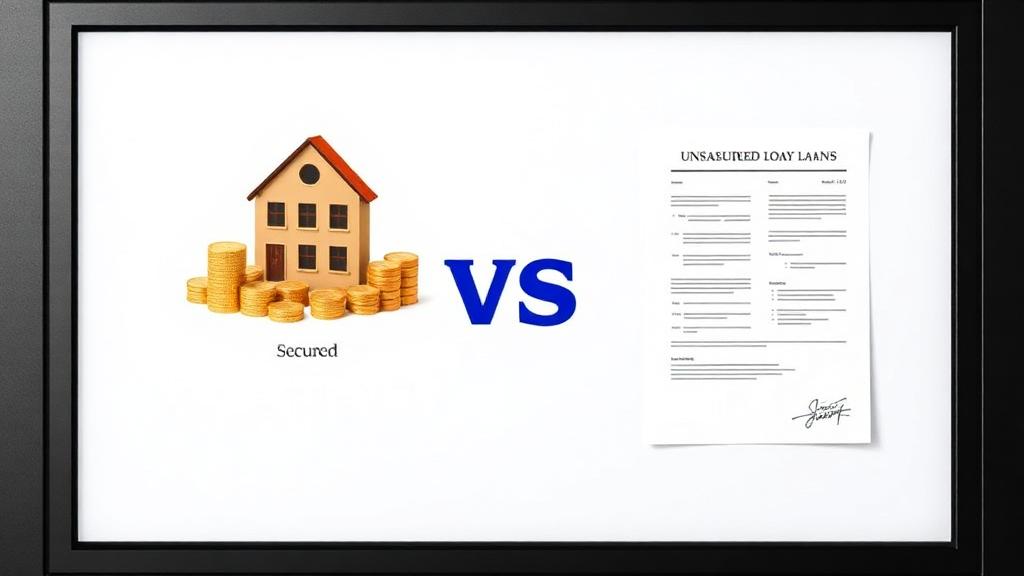
Unsecured vs. Secured Business Loans: An Entrepreneur's Guide
Learn the key differences between secured and unsecured business loans, including SBA loans, MCA options, and equipment funding to make the best financing decision for your business.
When seeking business financing, entrepreneurs inevitably arrive at a major fork in the road. It's a fundamental choice that impacts everything from your interest rate and loan amount to the level of personal risk you're willing to assume. This is the pivotal decision between a secured and an unsecured business loan. The difference between these two paths boils down to a single, powerful word: collateral.
Understanding this distinction is the most important step in choosing the right financial product for your company's specific assets, its tolerance for risk, and its unique stage of growth. Making the wrong choice can lead to higher costs or unnecessary risk, while the right choice can unlock growth and provide crucial stability. This guide will break down everything an entrepreneur needs to know, moving beyond simple definitions to explore the real-world implications of each option.
What is a Secured Business Loan?
A secured business loan is a form of financing that is backed by one or more assets of value, known as collateral. When you take out a secured loan, you enter into a legal agreement with the lender that pledges these assets as security. If, for any reason, you are unable to repay the loan according to the agreed-upon terms (an event known as a default), the lender has the legal right to seize and sell the pledged collateral to recoup their financial losses.
This security dramatically reduces the lender's risk, making them more willing to offer favourable terms like lower interest rates and higher loan amounts.
How Security is Formalized in the U.S.: The UCC-1 Financing Statement
In the United States, a lender's security interest in a business's assets is legally perfected by filing a UCC-1 Financing Statement. This is a public notice filed with the state's Secretary of State office, governed by the Uniform Commercial Code (UCC). The UCC-1 statement informs other potential creditors that the lender has a lien on, or a right to, the specified assets. This public filing establishes the lender's priority claim on that collateral, which is a critical step in the secured lending process.
Common Types of Collateral Accepted by Lenders
Businesses can leverage a wide range of assets to secure a loan. Some of the most common include:
Real Estate: This is a high-quality asset and includes commercial property like an office building, warehouse, storefront, or land that the business owns.
Equipment and Machinery: For many businesses, their equipment is their most valuable asset. This can include anything from heavy machinery and company vehicles to specialized manufacturing tools and computer hardware.
Accounts Receivable: This refers to the unpaid invoices your business has issued to its clients. Through a process called invoice financing, these future payments can be used as collateral to secure an advance.
Inventory: The stock of goods your business holds for sale can also be used as collateral, although lenders may value it at a lower percentage due to fluctuations in its worth.
- Blanket Liens: In some cases, a lender may place a blanket lien on all business assets, meaning nearly everything the business owns serves as collateral.
Pros and Cons of Secured Loans
Pros:
Lower Interest Rates: Because the lender's risk is significantly minimized, they reward borrowers with lower interest rates and a lower Annual Percentage Rate (APR). This can save your business thousands of dollars over the life of the loan.
Higher Loan Amounts: You can typically borrow a much larger sum of money with a secured loan. The loan amount is often determined by the Loan-to-Value (LTV) ratio of the collateral—the more your assets are worth, the more you can borrow.
Longer Repayment Terms: Lenders are often more comfortable offering longer repayment periods (amortization) on secured loans, which results in lower, more manageable monthly payments.
Cons:
Risk of Asset Seizure: This is the most significant drawback. You must be completely confident in your ability to repay the loan, as a default means you could lose the essential assets your business needs to operate.
Longer and More Complex Application Process: The lender must undertake a thorough due diligence process, which includes a formal appraisal to determine the value of the collateral, legal searches, and the official filing of the UCC-1 statement. This can take several weeks.
What is an Unsecured Business Loan?
An unsecured business loan is granted based on the borrower's creditworthiness and the financial strength of their business, without the need to pledge any specific collateral. The lender is taking on 100% of the financial risk in the event of a default.
Because there is no asset to seize, lenders make their decision by performing a deep analysis of factors that demonstrate your ability to generate consistent cash flow to service the debt. This includes your credit history, annual revenue, profitability, and time in business.
The Critical Role of the Personal Guarantee
While an unsecured loan doesn't require you to pledge a specific asset like your factory, it does not mean you are free of personal risk. Lenders almost always require the business owner(s) to sign a personal guarantee.
A personal guarantee is a legally binding agreement that makes you, the individual, personally responsible for repaying the debt if your business cannot. This means that if your business fails and defaults on the loan, the lender can pursue your personal assets—such as your family home, personal vehicle, and savings accounts—to satisfy the debt. This blurs the line between your business and personal finances and is a crucial factor to consider.
Pros and Cons of Unsecured Loans
Pros:
- Protects Your Assets: You do not have to pledge specific business assets, meaning your essential equipment and property are not directly on the line.
Faster Application Process: With no need for collateral appraisals or UCC-1 filings, the application and funding process is significantly faster. Many online lenders can provide unsecured funds in as little as 24-48 hours.
More Accessible for Certain Businesses: Companies that don't have significant physical assets, such as digital marketing agencies, software companies, consultants, and other service-based businesses, can more easily access this type of funding.
Cons:
Higher Interest Rates: To compensate for taking on all the risk, lenders charge much higher interest rates and fees on unsecured loans. The APR can be substantially higher than for a secured loan.
Lower Loan Amounts: The amount of capital you can borrow is typically lower, as it's based on your cash flow and creditworthiness rather than the value of your assets.
- Personal Guarantee Requirement: As mentioned, the required personal guarantee puts your personal financial well-being at risk.
The Middle Ground: The Role of the SBA in the U.S.
For many small businesses in the United States, loans guaranteed by the Small Business Administration (SBA) offer a powerful middle ground. The SBA does not lend money directly. Instead, it provides a guarantee to partner lenders (like banks and credit unions), insuring a large portion of the loan against loss. This government backing reduces the lender's risk, making it easier for small businesses to get approved for loans with favorable, long-term rates.
Popular options like the SBA 7(a) and 504 loan programs often function as secured loans, requiring collateral. However, the SBA's guarantee can sometimes allow for more flexibility on collateral requirements than a conventional bank loan, providing a pathway to affordable financing for businesses that might not otherwise qualify.
Which Option is Right for Your Business?
The best choice depends entirely on your business's unique situation, needs, and assets.
Choose a SECURED LOAN if:
- Scenario: You are a manufacturing company that needs $400,000 to purchase a new, state-of-the-art CNC machine.
Why it works: You have a factory building and other equipment to use as collateral. Your priority is getting the lowest possible interest rate and a long repayment term to keep monthly payments low. You are not in an extreme rush for the funds and can wait for the underwriting process.
Choose an UNSECURED LOAN if:
Scenario: You are a rapidly growing software consulting firm that just landed a major new client. You need $100,000 immediately to hire two new developers and purchase software licenses to begin the project.
Why it works: Your business has strong, predictable monthly revenue but very few physical assets. Your priority is speed to seize the opportunity. You are willing to pay a higher interest rate in exchange for immediate funding and are confident the new project's revenue will easily cover the debt.
Ultimately, the decision between secured and unsecured financing is a strategic balance of cost, speed, and risk. By carefully evaluating your assets, your urgency, and your comfort level with personal guarantees, you can confidently choose the path that will best fuel your entrepreneurial journey.
Ready to Get Started?
Use our Business Loan Estimator to see what financing options are available for your business.
Get My Loan Estimate