
Used vs New Equipment: Which One Do Lenders Prefer to Finance?
Acquiring commercial machinery is one of the largest capital decisions a business owner faces. When expanding operations, you must decide whether to buy brand-new machinery or opt for secondary market equipment. Canadian lenders evaluate both choices differently, balancing asset value against liquidation risk.
Canadian lenders generally prefer financing new commercial equipment because of predictable lifespans and standard manufacturer warranties. However, used equipment remains highly financeable when the machinery meets specific age limits, operational standards, and valuation criteria.
What do Canadian lenders prefer when financing equipment?
Canadian lenders generally prefer financing new equipment because it presents lower default risk and predictable collateral value. A brand-new asset carries a certified invoice value, minimal maintenance risk, and full warranty coverage. These factors make the machinery easier to appraise and liquidate if a business defaults on loan payments.
However, alternative financial institutions in Canada routinely approve financing for quality used equipment. While traditional banks enforce rigid requirements on asset age, specialized lender networks focus heavily on your overall revenue and commercial cash flow. Used equipment financing allows expanding companies to preserve capital while obtaining essential revenue-generating assets.
Whether you select new or pre-owned assets, approval depends on how well the machinery holds its value over time. Lenders review the useful life of the asset to structure repayment periods that protect both parties. Small businesses across Canada can secure equipment financing ranging from $5,000 to $800,000 based on their operational profile.
Why do lenders perceive higher risks with used commercial machinery?
Lenders perceive higher risk with used commercial machinery because pre-owned assets suffer from unpredictable wear and tear. Mechanical failures can cause unexpected operational downtime for your business. If a key piece of machinery stops working, business revenue drops, which increases the likelihood of missed loan payments.
Valuation uncertainty is another major challenge for financial institutions assessing secondary market equipment. Unlike new machinery with established manufacturer pricing, used equipment values fluctuate based on operating hours, physical condition, and regional market demand. Lenders must account for rapid depreciation when calculating the collateral security of a used machine.
In addition, secondary market transactions often lack comprehensive warranty protection. If a critical component breaks shortly after purchase, your business must absorb expensive repair bills out of pocket. Lenders offset this operational vulnerability by requesting larger down payments or shortening the overall loan duration on pre-owned items.
What are the financial advantages of buying new equipment for your business?
Buying new commercial equipment gives your business access to cutting-edge technology and maximum operational reliability right out of the box. Full manufacturer warranties eliminate surprise maintenance expenses during the initial years of operation. Reliable performance ensures your production schedules remain uninterrupted, keeping cash flow steady and predictable.
From a financing perspective, new machinery qualifies for the most attractive loan structures available in the commercial market. Lenders feel confident offering extended repayment terms and higher loan-to-value ratios because the underlying asset retains strong resale value. In many instances, qualified Canadian companies can finance up to 100 percent of a new machine's purchase cost.
New equipment also provides tax advantages through Canada Revenue Agency Capital Cost Allowance rules. Accelerated depreciation provisions often allow business owners to write off a significant portion of new capital investments quickly. This tax efficiency helps offset the higher initial purchase price of modern machinery.
When financing brand-new commercial assets, Canadian lenders often cover up to 100 percent of the purchase price. Used machinery generally requires a cash down payment between 10 and 20 percent to balance asset depreciation risk.
How do down payments and terms differ between new and used assets?
Financing terms for new commercial equipment typically span 36 to 72 months, whereas used equipment loans usually max out at 24 to 48 months. Lenders cap term lengths on pre-owned items to ensure the loan balance does not exceed the remaining useful life of the machinery. Shorter terms mean higher monthly payments, but you pay off the debt much faster.
Down payment requirements represent another key difference between new and secondary market transactions. New equipment approvals frequently demand zero down payment for businesses with established revenue and clean financial records. Conversely, used equipment transactions almost always mandate an upfront equity contribution to secure the financing agreement.
| Financing Factor | New Commercial Equipment | Used Commercial Equipment |
|---|---|---|
| Typical Loan Term | 36 to 72 months | 24 to 48 months |
| Down Payment Required | 0% to 10% | 10% to 20% |
| Loan-to-Value Ratio | Up to 100% | 70% to 90% |
| Third-Party Appraisal | Rarely required | Frequently required |
| Manufacturer Warranty | Included | Rarely included |
Understanding these fundamental structural differences enables you to prepare your cash reserves accurately before applying. If you want to conserve upfront cash, buying new may prove more economical despite the higher total purchase price. If you have cash on hand for a down payment, used machinery offers a lower total borrowing amount.
What key factors do lenders evaluate before approving used equipment financing?
Lenders evaluate asset age, operational hours, serial numbers, and maintenance records before approving used equipment financing. They want absolute proof that the machinery has been maintained according to professional standards throughout its operational lifespan. Clear record-keeping demonstrates that the previous owner cared for the investment properly.
Your business operational health is equally important when applying for secondary market loans. Canadian lenders check your monthly gross revenue, years in business, and general cash flow stability. Most alternative financing solutions require at least six months of business history and consistent monthly bank deposits to grant fast approval.
- Detailed maintenance logs and past service records from the seller
- Official equipment appraisal or independent mechanical inspection report
- Clear bill of sale with verified serial numbers and asset descriptions
- Proof of at least six months in business operation across Canada
- Recent business bank statements verifying consistent monthly cash flow
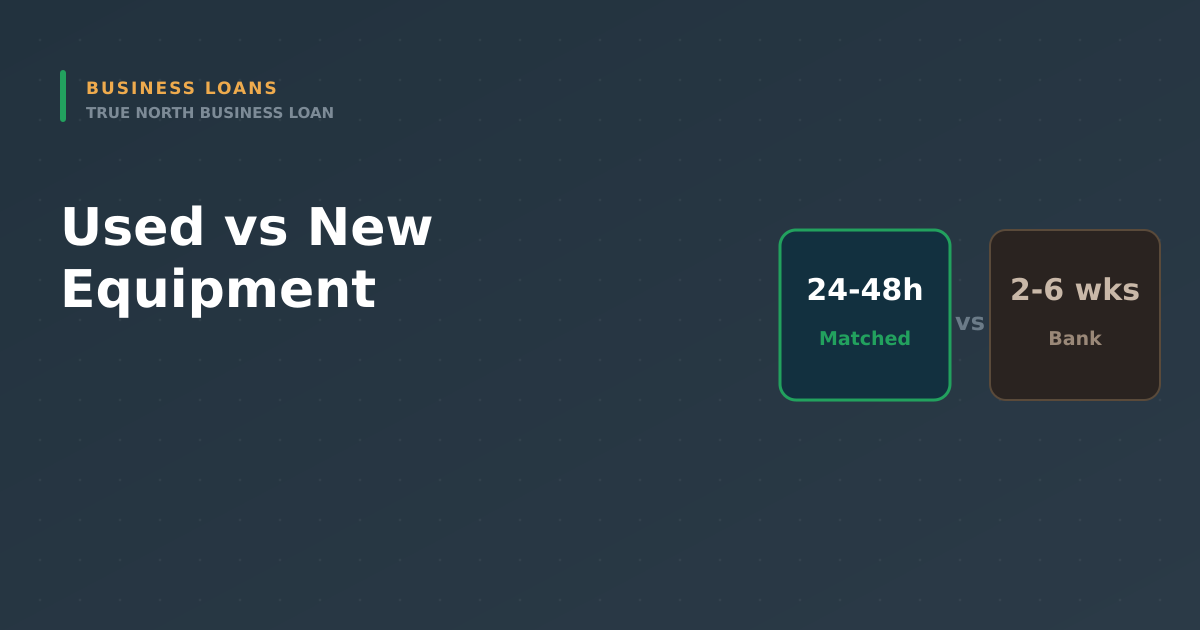
Gathering these essential documents before initiating an application speeds up approval times significantly. Having complete paperwork enables alternative lending networks to review your request and issue funding decisions within 24 to 48 hours. You can explore broader funding alternatives through small business loans to support secondary market purchases.
How can you avoid common pitfalls when applying for used equipment loans?
You can avoid common loan pitfalls by thoroughly verifying equipment age restrictions and seller credentials prior to applying. Attempting to finance equipment that exceeds lender age limits often results in immediate application rejections. Working with established commercial sellers or verified auction houses prevents unexpected verification hurdles during underwriting.
Another frequent mistake is ignoring the auxiliary costs associated with purchasing used commercial machinery. Beyond the purchase price, your company must fund transportation, rigging, installation, and initial recalibration expenses. Failing to account for these operational startup costs can strain working capital right after acquiring the machine.
- Financing machinery that exceeds lender maximum age limits for your industry
- Skipping independent mechanical inspections to save money upfront
- Underestimating shipping, setup, and immediate routine maintenance costs
- Applying only with traditional banks that maintain rigid credit thresholds
Working with flexible financing providers helps you navigate these potential traps effectively. By taking a comprehensive view of total acquisition expenses, you safeguard your business cash reserves while securing required hardware. Discovering your financing options takes under a minute with our loan estimator quiz, which performs a soft credit check without impacting your credit score.
How do you choose between buying new vs used for your operation?
Choose new equipment if your business relies heavily on nonstop production schedules, requires advanced technical features, and wants predictable monthly overhead. High-volume manufacturing plants and long-haul transportation fleets often benefit most from new machinery. The peace of mind provided by factory warranties protects heavy equipment users from catastrophic downtime expenses.
Choose used equipment if you need to scale operational capacity rapidly without taking on massive debt loads. Emerging businesses and seasonal operations frequently find pre-owned assets ideal for maintaining low capital expenditures. Secondary market equipment allows you to bypass extended manufacturer lead times and get machinery operating on site immediately.
Evaluate your projected return on investment for both scenarios before submitting loan applications. Calculate how much revenue the machinery will generate each month against estimated loan payments and maintenance costs. Selecting the option that maximizes cash flow ensures long-term operational health and easy debt servicing.
What is the process for securing equipment financing in Canada?
Securing equipment financing in Canada involves selecting your machinery, submitting financial documentation, and getting matched with compatible lenders. Streamlined digital platforms have replaced the tedious multi-week application processes historically enforced by traditional commercial banks. Modern financial technology matches your exact business profile with lenders ready to fund your industry.
The process starts with a brief online assessment detailing your business revenue and equipment needs. Lenders evaluate your request using soft credit checks that preserve your credit rating during the initial review phase. Once approved, loan agreements are finalized quickly, allowing funds to reach your bank account in as little as one business day.
This rapid funding turnaround allows Canadian business owners to capitalize on time-sensitive equipment deals in the secondary market. Whether purchasing from a local dealership, private vendor, or commercial auction, fast approvals keep your expansion plans on schedule. Accessing tailored equipment loans from $5,000 to $800,000 provides the foundation for sustainable business growth across Canada.
Frequently asked questions about new and used equipment financing
Do Canadian lenders finance used equipment bought from private sellers?
Yes, many Canadian alternative lenders finance used equipment purchased from private sellers. The transaction requires a clear bill of sale, verified serial numbers, and often an independent appraisal to confirm asset value.
What is the maximum age limit for financing used equipment?
Most Canadian lenders prefer used machinery to be under 10 years old at the time of financing. However, specialized equipment with long useful lifespans, such as heavy yellow iron or cranes, may qualify up to 15 years old.
How fast can equipment financing be approved in Canada?
Through alternative lender networks, equipment financing decisions are typically rendered within 24 to 48 hours. Once approved and contracts are signed, funding can arrive in your business bank account within one business day.
Will applying for equipment financing affect my personal credit score?
Initial loan matching and pre-qualification through soft credit checks do not affect your personal credit score. A hard credit inquiry is only performed once you formally accept a final loan offer from a specific lender.
Can I finance soft costs like delivery and installation with my machinery?
Yes, many equipment loan packages allow you to bundle soft costs such as delivery, installation, software, and training into the total loan amount, funding up to 100 percent of total project costs.
Ready to Get Started?
Use our Business Loan Estimator to see what financing options are available for your business.
Get My Loan Estimate