
Working Capital Loans in Canada: When to Use One and How to Qualify
What is a working capital loan for a small business?
A working capital loan is short-term business financing designed to cover everyday operating expenses rather than long-term capital assets. It funds payroll, inventory purchases, commercial rent, supplier invoices, and unexpected revenue lulls.
Unlike traditional mortgages or multi-year equipment loans, working capital financing focuses on operational liquidity. Canadian businesses frequently encounter gaps between delivering customer orders and collecting accounts receivable. These funding structures inject immediate capital to prevent operational bottlenecks.
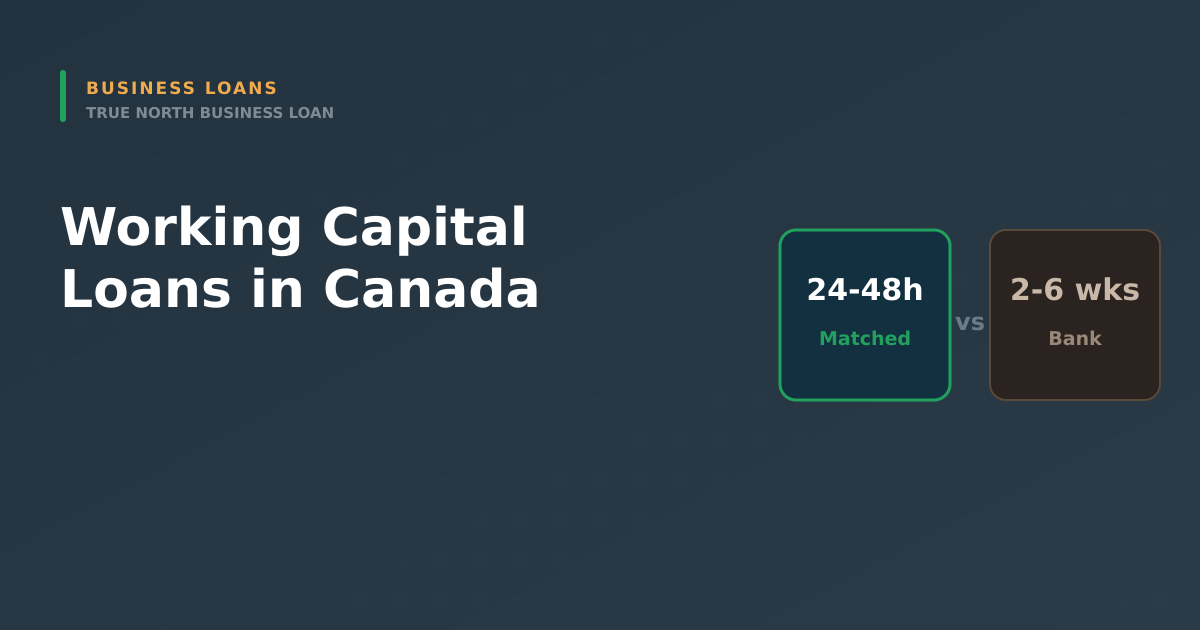
In Canada, working capital funding amounts generally range from $5,000 up to $800,000 depending on gross monthly revenue. Fast online alternatives assess your application within 24 to 48 hours, providing rapid access to cash when speed is critical.
When should a Canadian business use a working capital loan?
You should use a working capital loan when a temporary cash shortfall threatens daily operations or prevents you from capturing growth. Common situations include preparing for peak seasonal volume, securing bulk inventory discounts, or bridging delayed client invoicing terms.
Consider a seasonal retailer or landscaping contractor in Ontario or Alberta. In the weeks before peak season, inventory and staffing expenses surge before sales revenue materializes. A short-term facility provides the capital needed to stock inventory and hire staff without depleting reserve funds.
Another common use case is managing extended accounts receivable cycles. If you run a transportation or B2B manufacturing firm with net-60 terms, your fuel, drivers, and materials require upfront payment. Working capital bridges that timing gap seamlessly.
Conversely, working capital should never be used to subsidize chronic, structural business losses. Taking on short-term debt to cover long-term unprofitability creates compounding debt obligations that harm your enterprise over time.
What are the main types of working capital financing in Canada?
Canadian small businesses have access to several working capital products tailored to distinct revenue models and asset profiles. Selecting the correct structure depends on whether your sales are invoice-based, card-driven, or predictable month to month.
A standard small business loan delivers a fixed lump sum with predetermined repayment terms. For companies with outstanding corporate invoices, invoice factoring advances cash against unpaid receivables. High-volume retail stores and restaurants often choose a merchant cash advance, which remits payment as a percentage of daily card sales.
| Financing Type | Best Used For | Typical Repayment Structure |
|---|---|---|
| Term Business Loan | General operating expenses and inventory bulk orders | Fixed weekly, bi-weekly, or monthly installments |
| Invoice Factoring | Outstanding B2B invoices with 30 to 90 day payment terms | Cleared directly when customer pays the invoice |
| Merchant Cash Advance | Retail, hospitality, and businesses with high card volumes | Automated percentage of daily debit and credit card sales |
| Business Line of Credit | Ongoing liquidity buffers and unexpected emergency expenses | Monthly interest payments on the drawn amount |
How do you qualify for a working capital loan in Canada?
To qualify for a working capital loan in Canada, your business must demonstrate stable monthly deposits, an active operating history, and a Canadian commercial bank account. Alternative lenders emphasize overall cash flow strength rather than rigid personal credit score minimums.
Traditional chartered banks frequently demand multi-year audited financial statements and physical asset collateral. In contrast, modern alternative financing providers analyze recent bank statements to verify steady revenue deposits. This makes working capital accessible to newer or fast-growing businesses that banks routinely decline.
Lenders evaluate consistent deposit volume, average daily balances, and the absence of frequent non-sufficient fund events. Maintaining organized digital records allows underwriters to issue approvals within 24 to 48 hours.
- At least 6 months of continuous operating history in Canada
- Minimum monthly revenue of $10,000 deposited into a business account
- Recent 3 to 6 months of Canadian business bank statements
- Active Canadian business registration as a corporation, partnership, or sole proprietorship
What mistakes do business owners make with working capital loans?
The most frequent mistake business owners make is borrowing without a clear repayment plan or misjudging their repayment schedule. Because working capital facilities feature shorter terms, daily or weekly payment obligations must align with incoming cash flow.
Another serious error is using short-term working capital to purchase long-lived machinery or commercial vehicles. Long-term equipment should instead be funded with dedicated equipment financing, which amortizes cost across the full productive life of the asset.
- Borrowing more than needed: Accepting maximum loan limits instead of the required amount inflates financing costs and constrains daily cash flow.
- Stacking multiple short-term advances: Layering simultaneous loans creates severe cash flow compression that threatens business survival.
- Financing fixed assets with short debt: Purchasing long-term machinery with short-term capital depletes liquidity required for daily operations.
How does the application and funding timeline work?
The working capital financing process takes place entirely online, moving from initial assessment to deposited funds in as little as 24 to 48 hours. This streamlined structure eliminates the weeks of paperwork and branch visits required by traditional institutions.
You begin by completing a brief 60-second loan estimator quiz to match your industry and revenue profile with compatible lenders. This initial step uses a soft credit inquiry, ensuring your credit score remains unaffected while reviewing options.
After selecting an offer, you upload digital bank statements for automated cash flow verification. The lender confirms your deposit history, validates business registration, and issues digital loan agreements for electronic signature.
Once documents are executed, funds are transferred directly into your Canadian business bank account. You can deploy the capital immediately to manage payroll, buy inventory, or bridge receivables.
How do you calculate your actual working capital needs?
You calculate your working capital requirement by analyzing your cash conversion cycle and measuring the dollar shortfall during standard operating turnarounds. Subtracting short-term liabilities from liquid operational assets indicates whether your liquidity reserve is sufficient.
A practical formula examines your average monthly operating expenses multiplied by the days it takes to collect customer payments. If you incur $40,000 in monthly expenses and wait 45 days for invoice settlements, your business carries a $60,000 operational gap.
Adding a modest safety reserve protects your enterprise against unexpected supplier price hikes or late client payments.
Frequently asked questions about working capital loans
How fast can my Canadian business receive working capital funding?
Most alternative lending providers in Canada approve applications in 24 to 48 hours, with loan proceeds deposited into your business bank account within one to two business days.
Can I qualify for a working capital loan with a lower credit score?
Yes, alternative lenders focus primarily on your monthly business bank deposits and overall cash flow consistency rather than personal credit bureau scores.
How much working capital funding can my small business obtain?
Canadian small businesses can access working capital amounts between $5,000 and $800,000, depending on average monthly revenue and operating history.
Will checking working capital loan options impact my credit score?
No, initial eligibility checks use a soft credit pull that does not affect your personal credit rating or leave visible inquiries on your file.
What is the difference between working capital and equipment financing?
Working capital covers day-to-day operating overhead such as payroll and inventory, whereas equipment financing is secured specifically against machinery or commercial vehicles with multi-year terms.
Ready to Get Started?
Use our Business Loan Estimator to see what financing options are available for your business.
Get My Loan Estimate