
Is There a Maximum Interest Rate on Business Loans in Canada?
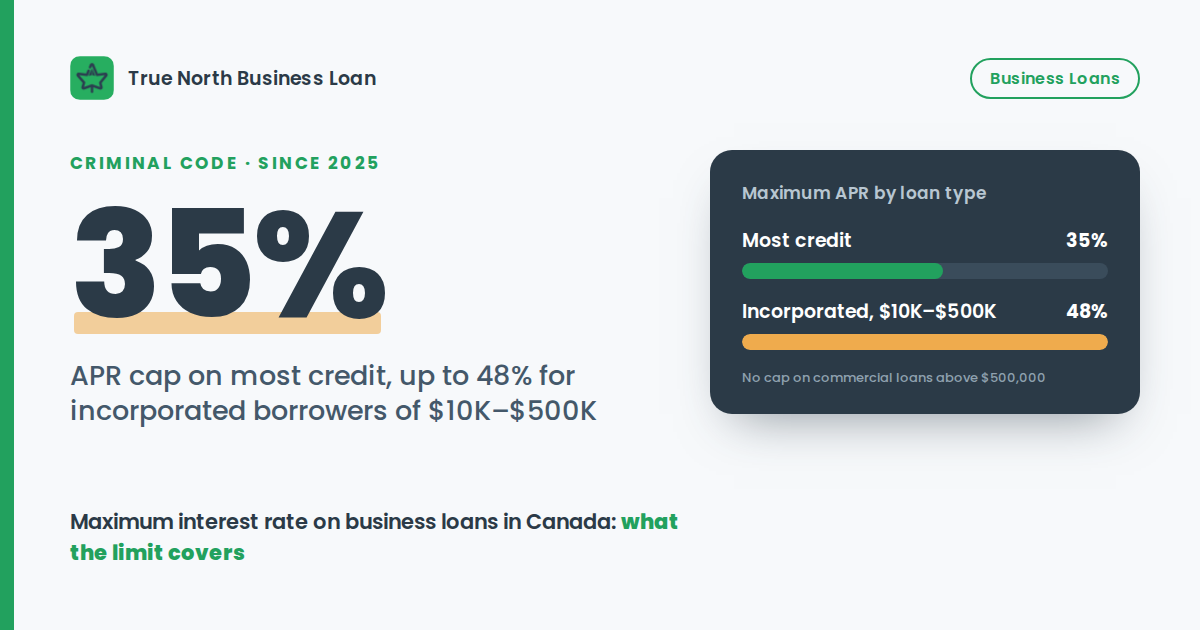
Yes. Since January 1, 2025, charging more than 35% APR on credit is a crime in Canada. Business loans get a different ceiling, though. If your company is incorporated and borrows $10,000 to $500,000 for business purposes, a lender can legally charge up to 48% APR. Above $500,000, there is no cap at all.
Most articles on this rule were written by law firms for lenders. This guide is for the borrower. It covers which limit applies to you, how to estimate the APR of an offer in dollars, and what to do if an offer looks too expensive.
The criminal rate is 35% APR for most credit. An incorporated business borrowing $10,000 to $500,000 for business use can be charged up to 48% APR. Over $500,000, the Criminal Code cap does not apply. Sole proprietors are people in law, so the 35% limit applies to them.
What is the maximum interest rate allowed in Canada?
Section 347 of the Criminal Code makes it an offence to lend at a "criminal rate". Parliament lowered that rate in 2024. It went from an effective annual rate above 60% to an annual percentage rate above 35%, starting January 1, 2025.
The switch from "effective annual rate" to "APR" matters. APR does not compound the way the old measure did, so the new ceiling is much lower than the headline change suggests. The Financial Consumer Agency of Canada uses the same 35% figure for consumer loans.
The rule applies to agreements made on or after January 1, 2025. Loans signed before that date are judged under the old 60% rule.
How does the limit change for business loans?
The Criminal Interest Rate Regulations (SOR/2024-114) carve out commercial loans. The exemption depends on three things: who borrows, why, and how much.
| Amount of credit | Incorporated business, business purpose | Sole proprietor or personal use |
|---|---|---|
| Under $10,000 | 35% APR cap | 35% APR cap |
| $10,000 to $500,000 | 48% APR cap | 35% APR cap |
| Over $500,000 | No Criminal Code cap | 35% APR cap |
The borrower must not be a "natural person". A corporation qualifies. A sole proprietorship does not, because the owner and the business are the same person in law. The money must also be for business or commercial purposes.
The government's explanation in the Canada Gazette says larger commercial deals show enough sophistication that the criminal cap is not needed. In practice, that means the $10,000 to $500,000 range is where most small business borrowers sit, and where the 48% ceiling applies.
What counts as interest under the Criminal Code?
Far more than the stated rate. Section 347 defines interest as the total of all charges for advancing credit. That includes fees, fines, penalties and commissions.
An origination fee, an admin fee or a broker commission paid to the lender side can all count. Repaying the principal does not. Nor do insurance charges, official fees such as registration costs, small overdraft charges, or required deposit balances.
This is why a loan quoted at 29% can still land above 35% APR. The fees push the true cost up. Always ask for the total cost of borrowing in dollars, not just the rate.
How do you estimate the APR of a loan offer?
You need three numbers: the cash you actually receive, each payment, and how many payments there are. The monthly rate that links them, multiplied by 12, is a good estimate of the APR.
- Find the net amount. Take the loan amount and subtract any fee deducted up front.
- List the payments. Note the amount and the frequency: daily, weekly or monthly.
- Solve for the periodic rate. Use the RATE function in Excel or Google Sheets: =RATE(payments, -payment, net amount).
- Annualize it. Multiply a monthly rate by 12, or a weekly rate by 52.
Here is an illustration in Canadian dollars. The numbers are made up to show the method, not taken from a real offer.
Example 1. A lender offers an incorporated business $40,000. It repays 12 monthly payments of $4,000, or $48,000 in total. With no fees, the estimated APR is about 35%. Now add a $1,200 fee deducted at funding. The business receives $38,800, and the estimated APR rises to about 41%.
That second offer is legal for a corporation using the money for business, since it is under 48%. The exact same offer to a sole proprietor would be above the 35% criminal rate.
Example 2. A business borrows $8,000 and repays six monthly payments of $1,550, or $9,300 in total. The estimated APR is about 54%. Because the amount is under $10,000, the 35% cap applies to every borrower, incorporated or not.
Short terms hide high APRs. Paying back $1.15 for every $1 over six months looks cheap, but it works out to well above 35% APR.
Does a merchant cash advance fall under the limit?
It depends on how the contract is built. A merchant cash advance is usually written as a purchase of your future card sales, not a loan. If it is a true sale, the provider argues that there is no "credit advanced" and no interest.
The substance of the deal matters more than the label. A fixed payment that is due no matter how your sales go, or a guarantee that makes you repay in full if sales stop, makes an advance look more like a loan. That question is for a lawyer, not a calculator.
What you can do yourself is convert the factor rate into an estimated APR with the steps above. Then compare it with a term loan or a line of credit before you sign. Our guide to merchant cash advance costs in Canada covers when an MCA still makes sense.
What should you do if an offer is above the limit?
Do not sign it to "sort it out later". Ask the lender for a written breakdown of every fee and the total cost of borrowing. Recalculate the APR with those numbers.
If the estimate is still above the cap that applies to you, ask the lender to restructure the offer. That could mean a longer term, a lower fee or a larger amount. If they refuse, walk away and get a second opinion from a lawyer or an accountant.
Comparing several offers at once is the fastest way to see what a fair price looks like for your file. The True North loan estimator takes about 60 seconds and shows which types of small business loans fit your business.
RelatedThe fees behind a business loan: what the rate does not tell youFrequently asked questions
What is the criminal interest rate in Canada in 2025?
It is 35% APR, for agreements made on or after January 1, 2025. Before that date, the limit was an effective annual rate of 60%.
Can a business loan charge more than 35% in Canada?
Yes, in two cases. An incorporated business borrowing $10,000 to $500,000 for business use can be charged up to 48% APR. Above $500,000, the Criminal Code cap does not apply.
Does the 48% exemption apply to sole proprietors?
No. The exemption requires a borrower that is not a natural person. A sole proprietor is a natural person in law, so the 35% APR limit applies.
Do fees count toward the 35% limit?
Yes. The Criminal Code counts fees, penalties, commissions and similar charges as interest. Insurance, official fees and repayment of principal are excluded.
Is a merchant cash advance subject to the criminal rate?
It depends on whether the contract is a true purchase of future sales or a loan in substance. Estimate its APR anyway, and ask a lawyer if the terms guarantee repayment regardless of sales.
Sources
- Criminal Code, section 347 (Justice Laws Website)
- Criminal Interest Rate Regulations, SOR/2024-114 (Justice Laws Website)
- Regulatory Impact Analysis Statement, Canada Gazette Part II, June 19, 2024
- Payday loans, Financial Consumer Agency of Canada
- New year, no criminal interest rate for commercial loans (Cassels)
This article explains the law in general terms and is not legal or financial advice. Examples are illustrations. Last reviewed September 30, 2026.
Ready to Get Started?
Use our Business Loan Estimator to see what financing options are available for your business.
Get My Loan Estimate