
CSBFP vs BDC: Which Government-Backed Business Loan Fits Your Business?
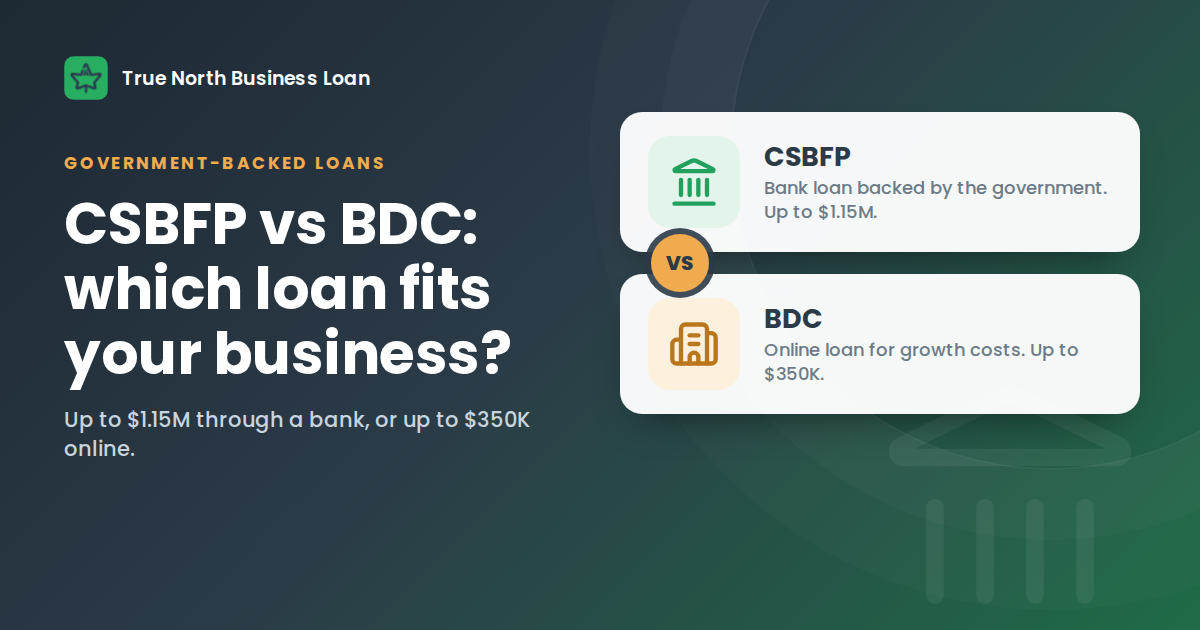
The CSBFP is a government guarantee on a loan from your own bank or credit union. BDC is a federal Crown corporation that lends to you directly. The CSBFP suits businesses buying equipment, property or leaseholds with a lender that already knows them. BDC's online Small Business Loan suits profitable companies that want up to $350,000 for growth costs, without pledging assets.
Both are cheaper than most alternative lenders. Both also say no to many young or thin-file businesses. This guide compares them with the official numbers, then covers what to do if neither fits.
Choose the CSBFP to finance equipment, leaseholds or real property: up to $1.15 million, a 2% registration fee, and a rate capped at prime + 3% on floating term loans. Choose BDC's Small Business Loan for soft costs like inventory, marketing or hiring: up to $350,000, usually 24 months in business, a 600+ credit score and current profits. If you have less history than that, an alternative lender may be the only fast option, at a higher cost.
What is the difference between the CSBFP and BDC?
The CSBFP is not a lender. It is a federal program run by Innovation, Science and Economic Development Canada (ISED). Your bank, caisse populaire or credit union makes the loan, and the government shares the risk if you default. ISED states that "financial institutions are solely responsible for making the decision to approve a loan."
BDC is a bank owned by the federal government. You apply to BDC itself, and BDC decides. Its Small Business Loan is a standard online product. BDC also offers larger, custom loans through an advisor, which this guide does not cover.
That difference drives everything else. With the CSBFP, you start at your own branch. With BDC, you apply online or through a BDC account manager.
Who qualifies for each program?
The CSBFP is broader on paper. BDC's online loan has firmer entry rules. Here is how they compare.
| CSBFP (through your bank) | BDC Small Business Loan | |
|---|---|---|
| Revenue limit | Gross revenue of $10 million or less | At least $100K a year (loans up to $100K) or $250K (larger loans) |
| Time in business | Start-ups eligible | 24 months (12 to 24 months possible, with longer approval and extra fees) |
| Profitability | Lender's own credit rules | Must currently be profitable |
| Personal credit | Lender's own credit rules | Score of 600 or higher |
| Excluded | Farming businesses; share purchases; assets bought by a holding company | Businesses outside Canada |
| Maximum amount | $1.15 million in total | $350,000 |
Sources: ISED, Helping small businesses get loans; BDC, Small Business Loan.
"Start-ups eligible" does not mean start-ups get approved. The bank still applies its normal credit review. In practice, a lender wants to see a plan, some owner equity and a way to repay.
What can you finance with each one?
The CSBFP is built for hard assets. ISED lists these limits inside the $1.15 million cap:
- Term loans: up to $1,000,000 in total.
- Equipment and leasehold improvements: up to $500,000.
- Intangible assets and working capital: up to $150,000.
- Lines of credit: up to $150,000.
Eligible uses include commercial vehicles, equipment, land and buildings, leasehold renovations, franchise purchases and technology.
BDC's online loan goes the other way. Its listed uses are soft costs: inventory, marketing, hiring, supplier payments, product development, certifications and entering new markets.
So the product often picks itself. A $200,000 truck or an oven fits the CSBFP. A $60,000 marketing push and a new hire fit BDC.
How much does each one cost?
The CSBFP publishes its ceilings. BDC prices each file. The CSBFP guidelines cap rates and list the fees a borrower may pay.
| Cost | CSBFP | BDC Small Business Loan |
|---|---|---|
| Rate, floating | Up to the lender's prime + 3% | BDC floating base rate + a variance set for your file |
| Rate, fixed | Up to the lender's residential mortgage rate for the term + 3% | Not offered on this product |
| Rate, line of credit | Up to the lender's prime + 5% | Not applicable |
| Upfront fee | 2% of the amount loaned (can be financed) | No application fee up to $100K; "certain fees" above |
| Other charges | Possible approval, security and insurance costs | No prepayment fee up to $100K |
| Repayment | Up to 15 years of government coverage | 5 years (up to $100K) or up to 8 years (above) |
| Interest-only start | Set by the lender | Up to 6 months (up to $100K) or 12 months (above) |
Worked example. A café borrows $300,000 under the CSBFP for equipment and leaseholds. The registration fee is 2% of $300,000, or $6,000. If it is financed, the loan becomes $306,000. The floating rate can be no higher than the bank's prime rate plus 3 percentage points.
Always compare offers by total cost, not just the rate. Our guide to the maximum interest rate on business loans in Canada shows how fees turn into an APR.
How long does approval take?
BDC is the faster of the two for small amounts. It states approval "in less than 10 days" for loans up to $100,000 and "less than 30 days" for larger ones.
The CSBFP has no published timeline, because each lender runs its own process. Expect the same time as a regular bank loan, plus time to register the loan with the program. Buying equipment also means quotes, invoices and security paperwork.
What if the bank or BDC says no?
A decline usually comes down to one of four things: too little time in business, low or no profit, a credit score under about 600, or not enough security. Each has a different fix.
- Ask why. Lenders will usually tell you which rule you missed. Write it down.
- Try the other program. A BDC decline for lack of profit does not stop a bank from making a CSBFP equipment loan backed by the asset.
- Try a second lender. CSBFP rules are the same at every bank, but credit appetite is not. A credit union may say yes where a big bank said no.
- Shrink or split the request. BDC's thresholds change at $100,000. Staying under it lowers the revenue bar to $100K and shortens approval.
- Fix the file and come back. Six more months of clean statements can change the answer.
When is an alternative lender worth the extra cost?
When time or eligibility rules out both programs, and the money earns more than it costs. Alternative lenders often fund in days and accept shorter histories. They also charge more, so the math has to work.
An alternative loan can make sense when:
- You have a signed contract or purchase order that you cannot fill without cash now.
- You are under 24 months in business, with steady deposits but no profit yet.
- The cost of waiting, such as a lost contract or a missed season, is bigger than the extra interest.
It rarely makes sense to cover ongoing losses. Borrowing expensive money to pay regular bills usually makes the next month harder.
If you go this route, get the APR in writing and check it against the legal limits. Compare at least two offers. The True North loan estimator takes about 60 seconds and shows which small business loan types fit your business, from $5K to $800K. For a side-by-side of the two lender types, see bank vs alternative lender.
Frequently asked questions
Is the CSBFP a grant?
No. It is a loan that you repay with interest. The government guarantees part of it to the lender, which makes the bank more willing to lend.
Can I get a CSBFP loan and a BDC loan at the same time?
Nothing in either program's published rules forbids it. Each lender will count the other debt when it reviews your ability to repay.
Do I need a personal guarantee for a CSBFP loan?
Usually, yes. The CSBFP guidelines let a lender take unsecured personal guarantees up to the original amount of the loan. Security on the financed assets is also required.
Can a start-up get a BDC Small Business Loan?
Not the standard online version. It asks for 24 months in business and current profits. BDC has separate start-up financing, and the CSBFP is open to start-ups through a bank.
What is the CSBFP registration fee?
It is 2% of the amount loaned, paid once. It can be added to the loan.
Sources
- Helping small businesses get loans, Canada Small Business Financing Program (ISED)
- Canada Small Business Financing Program Guidelines (ISED)
- Frequently asked questions for small businesses, CSBFP (ISED)
- Small Business Loan (BDC)
This article explains public program rules in general terms and is not financial advice. Program limits and rates can change; confirm them with the lender before you apply. Last reviewed September 30, 2026.
Ready to Get Started?
Use our Business Loan Estimator to see what financing options are available for your business.
Get My Loan Estimate