
Factor Rate to APR: What an MCA Really Costs in Canada
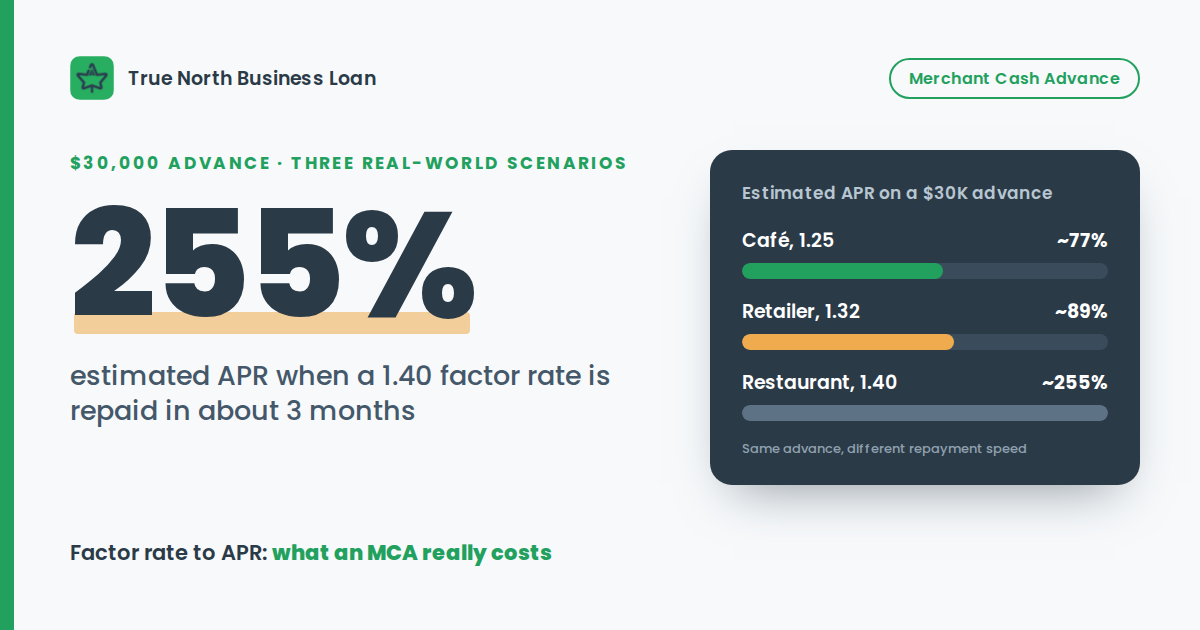
A merchant cash advance with a factor rate of 1.25 to 1.40 can cost the equivalent of about 77% to 255% APR in our three examples (and around 54% even if your sales drop 30%), depending on how fast your sales repay it. The factor rate tells you the total cost, not the annual rate, because your sales set the term.
Below: how to convert a factor rate into an APR, a $30,000 advance worked out in three sales scenarios, where the Criminal Code limits fit, and cheaper options to check first.
Advance × factor rate = total payback. Payback ÷ daily remittance = term. A spreadsheet RATE function then gives the APR. On a $30,000 advance, our three examples range from about 77% to 255% APR. The faster you repay, the higher the APR, because the same fee is paid over a shorter time.
What is a factor rate, and why is it not an interest rate?
A factor rate is a multiplier that sets the total amount you pay back. A $30,000 advance at a factor rate of 1.30 means you repay $39,000. The $9,000 difference is the cost, and it is fixed on day one.
An interest rate works differently. Interest is charged on the balance you still owe, over time. If you repay a loan early, you usually pay less interest. With a factor rate, the cost is usually the same whether you repay in three months or ten, unless the contract offers an early payoff discount.
So a factor rate of 1.30 is not "30% interest". It is 30% charged once, often over less than a year. Annualized, it is much higher.
Most advances are repaid through a holdback: a fixed percentage of your daily card sales, taken by the provider or your payment processor until the payback amount is reached. Some providers instead debit a fixed amount from your bank account each business day. Our merchant cash advance page explains how the product works in more detail.
How do you convert a factor rate into an APR?
You need four numbers: the advance, the factor rate, the holdback percentage and your average daily card sales.
- Find the total payback. Advance × factor rate. Example: $30,000 × 1.25 = $37,500.
- Find the daily remittance. Holdback % × average daily card sales. Example: 10% × $2,500 = $250 a day.
- Estimate the term. Total payback ÷ daily remittance. Example: $37,500 ÷ $250 = 150 business days, about 7 months.
- Solve for the APR. In Excel or Google Sheets: =RATE(150, -250, 30000) × 252. That returns about 77%.
We use 252 business days a year because most remittances are collected on weekdays. If your provider collects every calendar day, use 365 days and your daily sales across all seven days instead. If a fee is deducted from the advance, put the net amount you actually receive in the RATE formula. A $750 fee on the example above lifts the APR from about 77% to about 87%.
Without a spreadsheet: APR ≈ (factor rate − 1) × 2 ÷ term in years. For the example, 0.25 × 2 ÷ (150 ÷ 252) = 84%. The shortcut runs high, by a few points on longer terms (84% vs 77% here) and by much more on short ones (about 288% vs 255% for a three-month advance), so use RATE for the final number. The "× 2" is there because your balance falls every day, so on average you only hold about half the money.
How much does a $30,000 merchant cash advance cost in three sales scenarios?
The table applies the same method to three illustrative offers. They show the math; they are not quotes from a real provider.
| Scenario | A: steady café | B: slower retailer | C: busy restaurant |
|---|---|---|---|
| Advance | $30,000 | $30,000 | $30,000 |
| Factor rate | 1.25 | 1.32 | 1.40 |
| Total payback | $37,500 | $39,600 | $42,000 |
| Cost of the advance | $7,500 | $9,600 | $12,000 |
| Holdback | 10% | 12% | 15% |
| Average daily card sales | $2,500 | $2,000 | $4,000 |
| Daily remittance | $250 | $240 | $600 |
| Estimated term | 150 business days (about 7 months) | 165 business days (about 8 months) | 70 business days (about 3 months) |
| Estimated APR | about 77% | about 89% | about 255% |
Every scenario is far above the 35% and 48% APR limits that apply to loans. Scenario C costs $4,500 more than A in dollars, yet its APR is more than three times higher, because it is repaid in about three months. And the APR moves with your sales.
If sales in scenario A drop 30% to $1,750 a day, the remittance falls to $175, the term stretches to about 214 business days (roughly 10 months), and the estimated APR falls to about 54%. The dollar cost stays at $7,500. That is not a better deal: the same fee is spread over a slower season, and 10% of your card sales is gone for longer.
Does the 35% or 48% criminal rate apply to a merchant cash advance?
It depends on how the contract is built, and that is a legal question. Since January 1, 2025, section 347 of the Criminal Code sets the criminal rate at more than 35% APR on credit advanced. The Criminal Interest Rate Regulations (SOR/2024-114) allow up to 48% APR when the borrower is not a natural person, the money is for business, and the credit is more than $10,000 and up to $500,000. Above $500,000, there is no Criminal Code cap.
Most merchant cash advances are written as a purchase of your future receivables, not a loan. The provider's position is that it bought a share of your sales, so there is no "credit advanced" and no "interest" to measure against the cap.
Canadian courts look at substance, not labels. In Hybrid Financial Ltd. v. Flow Capital Corp., 2022 ONCA 820, the Ontario Court of Appeal reviewed a financing written as a "royalty purchase". It found that, in substance, money was advanced and had to be paid back, so section 347 applied. That case was not about a merchant cash advance, and each contract is different. It does show why these features deserve a close read:
- A fixed daily debit. If you pay the same amount whatever your sales, the deal looks more like a loan.
- No reconciliation clause. A true share of sales should let payments fall when sales fall.
- A guarantee of repayment. A personal guarantee that covers the full balance, not just your honest performance, shifts the risk back to you.
- Default triggers on slow sales. If a drop in sales lets the provider demand the whole balance, the risk is not really shared.
If a contract has these features, ask a lawyer to review it before you sign. Our guide to the maximum interest rate on business loans in Canada explains the 35% and 48% limits in more detail.
When does a merchant cash advance still make sense?
When speed matters more than price and the money earns more than it costs. It is a short-term tool, not long-term funding.
- You need the money in days, for a specific use with a clear payback, such as inventory you already know will sell.
- The gross profit from that use is clearly larger than the dollar cost of the advance.
- Most of your revenue comes through card sales, and it is steady enough to estimate the term.
- The contract has a true holdback with reconciliation, so payments fall if sales fall.
- You have checked the cheaper options below and do not qualify for them yet.
It rarely makes sense to cover ongoing losses, to repay another advance, or to take a new advance before the current one is paid off. Each renewal starts a new fee on money you already had.
What are the cheaper alternatives to a merchant cash advance?
With steady revenue and fair credit, at least one of these usually costs less. Convert every offer to an APR with the same RATE method to compare like with like.
| Option | Best for | What to know |
|---|---|---|
| Business line of credit | Recurring cash flow gaps | You pay interest only on what you draw. Under the CSBFP, a bank line of credit can go up to $150,000, at no more than the lender's prime rate plus 5%, plus a 2% registration fee. |
| Invoice factoring | B2B businesses waiting on customer invoices | You sell unpaid invoices instead of future card sales. The fee is based on how long your customers take to pay, so it tends to cost less when they pay quickly. |
| Term loan | One-off projects, inventory, hiring | BDC's Small Business Loan goes up to $350,000. Under $100,000, BDC lists approval in under 10 days and a 5-year amortization, for businesses with 24 months of history, $100K+ in revenue and a credit score of 600+. |
| CSBFP term loan | Equipment, leaseholds, property, some working capital | Up to $1.15 million in total through your bank or credit union. Floating rates are capped at prime plus 3%, and there is a 2% registration fee. |
For a full comparison of the two government-backed options, see CSBFP vs BDC. If you are not sure which of these you qualify for, the True North loan estimator takes about 60 seconds and shows which financing types fit your business before you commit to an advance.
RelatedMerchant cash advance in Canada: costs, pros and when it fitsFrequently asked questions
Is a factor rate of 1.3 the same as 30% interest?
No. A factor rate of 1.3 means you repay 30% more than you received, as a one-time cost. If you repay over six months (about 126 business days), the estimated APR is roughly 100% or more (about 109%), because you pay that cost over half a year and your balance falls every day.
What is the difference between the factor rate and the holdback?
The factor rate sets how much you repay in total. The holdback sets how fast you repay it, as a percentage of your daily card sales. Together with your sales, they decide the term and the APR.
Does paying a merchant cash advance off early save money?
Usually not. The payback amount is fixed at signing, so repaying faster does not lower it unless the contract includes an early payoff discount. Ask for that discount in writing before you sign.
Is a merchant cash advance subject to Canada's criminal interest rate?
It depends on whether the contract is a true purchase of future sales or a loan in substance. Ontario's Court of Appeal has looked past a "purchase" label before. If the terms guarantee repayment regardless of sales, ask a lawyer.
What happens to my payments if my sales drop?
With a true percentage holdback, your daily payment falls with your sales and the term gets longer. With a fixed daily debit, the payment stays the same. Check for a reconciliation clause that lets you adjust payments to actual sales.
Sources
- Criminal Code, section 347 (Justice Laws Website)
- Criminal Interest Rate Regulations, SOR/2024-114 (Justice Laws Website)
- Regulatory Impact Analysis Statement, Canada Gazette Part II, June 19, 2024
- Hybrid Financial Ltd. v. Flow Capital Corp., 2022 ONCA 820 (Court of Appeal for Ontario)
- Helping small businesses get loans, Canada Small Business Financing Program (ISED)
- Small Business Loan (BDC)
This article explains general concepts and is not legal or financial advice. The scenarios are illustrations calculated by True North, not offers from a real provider. Program limits and rates can change; confirm them with the lender before you apply. Last reviewed September 30, 2026.
Ready to Get Started?
Use our Business Loan Estimator to see what financing options are available for your business.
Get My Loan Estimate